Principal AI Engineer Roadmap (2026)
Part 15 – Principal AI Engineer Capstone Project & Career Roadmap
The final chapter combines every concept learned throughout this roadmap into one production-grade enterprise AI platform while providing a complete career roadmap for becoming a Principal AI Engineer.
Course Completion
Congratulations on completing the Principal AI Engineer Roadmap (2026). Over the previous fourteen chapters, you explored the complete AI engineering lifecycle—from software engineering fundamentals and mathematics to Machine Learning, Deep Learning, Natural Language Processing, Generative AI, Prompt Engineering, Retrieval-Augmented Generation (RAG), AI Agents, FastAPI, Docker, Kubernetes, MLOps, LLMOps and Enterprise AI System Design. This final chapter focuses on transforming that knowledge into a production-grade portfolio project that demonstrates the capabilities expected of a Principal AI Engineer.
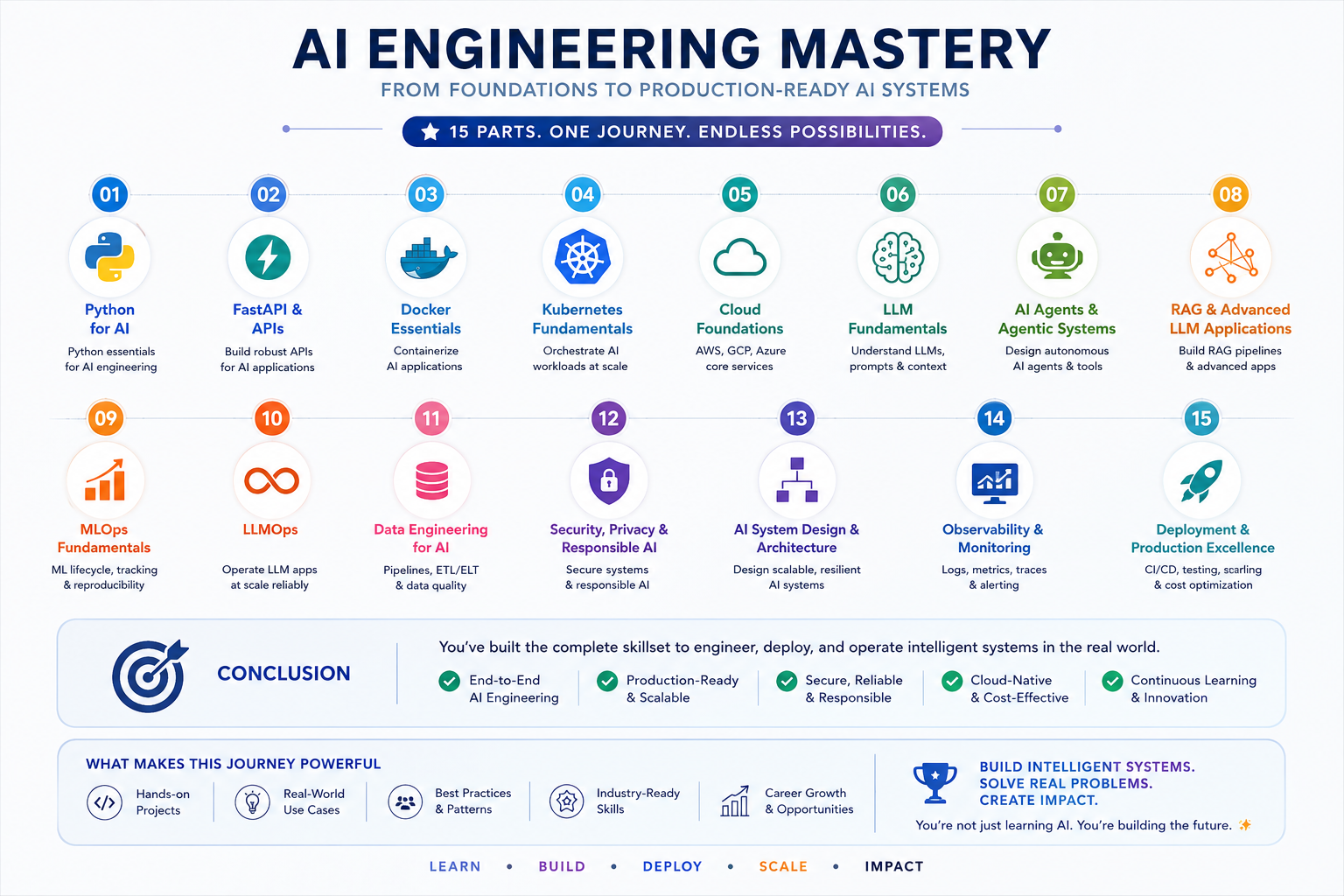
Enterprise Capstone Project
The best way to prove your AI engineering skills is by building a real-world system that combines modern AI capabilities with enterprise software engineering practices.
Enterprise AI Knowledge & Automation Platform
Develop a production-ready AI platform capable of answering questions, searching organizational knowledge, automating workflows and integrating securely with enterprise systems.
| Module | Business Value |
|---|---|
| Enterprise AI Chat Assistant | Natural language interface for employees and customers |
| RAG Knowledge Search | Ground responses using enterprise documents |
| Document Intelligence | Extract information from PDFs, reports and contracts |
| Meeting Notes Generator | Create summaries and action items automatically |
| AI Workflow Automation | Automate repetitive business processes |
| Code Review Assistant | Improve developer productivity |
| Email & Report Generator | Generate business-ready communication |
| Prompt Management Portal | Manage prompt versions and templates |
| Analytics Dashboard | Track usage, latency, quality and cost |
| User & Role Management | Authentication, RBAC and audit logging |
Recommended Technology Stack
| Layer | Technology | Purpose |
|---|---|---|
| Frontend | React / Angular | User interface |
| Backend | Python + FastAPI | Business APIs |
| LLMs | GPT, Claude, Gemini, Llama | Reasoning and content generation |
| AI Framework | LangChain / LlamaIndex | RAG and workflow orchestration |
| Vector Database | Qdrant / Pinecone / Chroma | Semantic search |
| Relational Database | PostgreSQL | Application data |
| Cache | Redis | Performance optimization |
| Messaging | Kafka / RabbitMQ | Asynchronous processing |
| Containerization | Docker | Portable deployments |
| Orchestration | Kubernetes | Scaling and resilience |
| CI/CD | GitHub Actions | Automated deployment |
| Cloud | AWS / Azure / Google Cloud | Production hosting |
| Monitoring | Prometheus + Grafana | Observability |
| Tracing | OpenTelemetry | Distributed tracing |
Reference Enterprise Architecture
                         Users
                           │
                    API Gateway
                           │
                 Authentication & RBAC
                           │
                     AI Gateway Layer
       ┌───────────────┬──────────────┬──────────────┐
       │               │              │              │
 Prompt Service    RAG Service   Agent Service  Model Router
       │               │              │              │
       └───────────────┴──────────────┴──────────────┘
                           │
                   Large Language Models
                           │
          ┌───────────────┼─────────────────┐
          │               │                 │
     Vector DB       PostgreSQL         Redis
          │               │                 │
          └───────────────┼─────────────────┘
                           │
              Monitoring • Logging • Tracing
        Prometheus • Grafana • OpenTelemetry
Suggested GitHub Repository Structure
enterprise-ai-platform/

├── frontend/
├── backend/
├── rag/
├── agents/
├── prompts/
├── evaluation/
├── docker/
├── kubernetes/
├── helm/
├── terraform/
├── tests/
├── docs/
├── .github/
└── README.md
A clean repository structure demonstrates engineering maturity and makes collaboration easier for enterprise teams.
Suggested Delivery Roadmap
| Sprint | Deliverables |
|---|---|
| 1 | Project setup, authentication, FastAPI foundation |
| 2 | LLM integration and prompt management |
| 3 | Document ingestion and vector indexing |
| 4 | Complete Retrieval-Augmented Generation pipeline |
| 5 | AI Agents with tool calling and workflow automation |
| 6 | Docker containerization and Kubernetes deployment |
| 7 | CI/CD automation using GitHub Actions |
| 8 | Monitoring, logging and tracing |
| 9 | Security hardening and performance optimization |
| 10 | Documentation, demo video and portfolio publication |
Principal AI Engineer Competency Matrix
Python Software Engineering Machine Learning Deep Learning Natural Language Processing Generative AI Prompt Engineering Retrieval-Augmented Generation AI Agents FastAPI Docker Kubernetes Cloud MLOps LLMOps System Design LeadershipPortfolio Projects
A strong portfolio demonstrates that you can build complete AI platforms, not just notebooks or prototypes.
- Enterprise RAG Knowledge Platform
- AI Meeting Assistant
- Enterprise Document Intelligence System
- Customer Support AI Agent
- Multi-Agent Workflow Automation Platform
Every Project Should Include
- Architecture diagrams
- Well-documented source code
- Docker support
- Kubernetes deployment
- CI/CD pipeline
- Automated tests
- Monitoring dashboards
- Security considerations
- API documentation
- Screenshots and demo video
Career Growth Roadmap
| Timeline | Primary Focus |
|---|---|
| 0–6 Months | Python, SQL, Linux, Git, Statistics, Machine Learning |
| 6–12 Months | Deep Learning, NLP, FastAPI, LLMs and Prompt Engineering |
| 12–18 Months | RAG, AI Agents, Docker, Kubernetes, MLOps and LLMOps |
| 18–24 Months | Enterprise Architecture, Technical Leadership and AI Strategy |
Principal AI Engineer Readiness Assessment
Before applying for senior AI engineering roles, ensure you can confidently answer YES to most of the following questions.
✓ I understand Machine Learning and Deep Learning fundamentals.
✓ I can explain Transformer architecture and Large Language Models.
✓ I can build production-grade RAG applications.
✓ I know when to choose RAG, fine-tuning or AI Agents.
✓ I can expose AI services through FastAPI APIs.
✓ I can deploy production workloads using Docker and Kubernetes.
✓ I understand MLOps and LLMOps practices.
✓ I can monitor quality, latency, reliability and cost.
✓ I can secure AI applications against prompt injection and data leakage.
✓ I can lead architecture discussions and mentor engineering teams.
Recommended Learning Resources
- Designing Data-Intensive Applications
- Deep Learning – Ian Goodfellow
- Machine Learning Engineering
- Building LLM Applications
- Attention Is All You Need (Research Paper)
- Kubernetes Documentation
- FastAPI Documentation
- OpenTelemetry Documentation
- MLflow Documentation
- LangChain & LlamaIndex Documentation
Beyond This Handbook
Artificial Intelligence evolves at an extraordinary pace. New models, frameworks and research papers emerge every month, but the engineering principles behind successful AI systems remain remarkably consistent.
Continue strengthening your software engineering skills while staying current with advances in AI. Build production-grade systems, contribute to open-source projects, participate in architecture discussions, write technical blogs and continuously evaluate new technologies with an engineering mindset.
The most successful AI engineers are not those who memorize APIs—they are the ones who understand systems, solve real business problems and continuously adapt to change.
Closing Thoughts
Artificial Intelligence is reshaping every industry, but exceptional AI systems are still built on timeless engineering principles: clean architecture, scalable software, operational excellence, security and continuous learning.
Throughout this roadmap, you progressed from software engineering fundamentals to enterprise-scale AI architecture. Together, these disciplines form the foundation of a modern Principal AI Engineer capable of designing, building and operating reliable AI platforms that deliver measurable business value.
Models will change.
Frameworks will evolve.
APIs will be replaced.
But strong engineering fundamentals, thoughtful architecture and the ability to solve real-world problems will always remain valuable.
Congratulations!
You have successfully completed the Principal AI Engineer Roadmap (2026). Use this handbook as a living reference, continue building production-grade AI systems, share your knowledge with others, contribute to the engineering community and never stop learning. Your journey doesn't end here—it begins with the systems you build next.