Principal AI Engineer Roadmap (2026)
Part 05 – Deep Learning & Neural Networks
Understand how modern neural networks power computer vision, speech recognition, recommendation systems and Large Language Models.
Introduction
Deep Learning is the engine behind today's Artificial Intelligence revolution. From ChatGPT and autonomous vehicles to medical imaging, recommendation systems, speech recognition and multimodal AI, nearly every breakthrough in modern AI is powered by deep neural networks.

Unlike traditional Machine Learning algorithms that rely heavily on manually engineered features, Deep Learning models automatically learn hierarchical representations directly from massive datasets. This ability enables AI systems to understand images, language, audio and complex relationships with unprecedented accuracy.
For a Principal AI Engineer, understanding Deep Learning means more than training neural networks—it means knowing how to design, deploy, optimize and scale intelligent systems that solve real-world business problems.
Deep Learning transformed AI from systems that recognize patterns into systems capable of understanding language, vision, reasoning and generation.
How Deep Learning Works
A neural network consists of interconnected artificial neurons that progressively transform raw input data into meaningful representations. During training, millions—or even billions—of parameters are adjusted to minimize prediction errors using optimization algorithms.
Output = Activation((Inputs × Weights) + Bias)
Although modern frameworks perform these calculations automatically, understanding the learning process helps engineers troubleshoot training failures, optimize architectures and improve model performance.
Core Components of Neural Networks
| Component | Role | Enterprise Importance |
|---|---|---|
| Input Layer | Receives raw features | Images, text, sensor data or tabular datasets |
| Hidden Layers | Extract complex representations | Automatic feature learning |
| Activation Functions | Introduce non-linearity | Enable learning of complex relationships |
| Loss Function | Measures prediction error | Guides optimization |
| Optimizer | Updates model parameters | Controls learning efficiency |
| Output Layer | Produces final prediction | Classification, regression or generation |
Popular Activation Functions
| Activation | Common Usage |
|---|---|
| ReLU | Default activation for hidden layers |
| Sigmoid | Binary classification outputs |
| Tanh | Zero-centered activations |
| Softmax | Multi-class probability distributions |
| GELU | Modern Transformer architectures including GPT and BERT |
Deep Learning Training Pipeline
- Collect and prepare high-quality datasets
- Build the neural network architecture
- Initialize model parameters
- Perform forward propagation
- Calculate prediction loss
- Run backpropagation
- Update weights using an optimizer
- Validate performance
- Repeat over multiple epochs
- Export the trained model for inference
- Deploy and continuously monitor production performance
Production Deep Learning extends well beyond training—it includes deployment, observability, retraining and continuous optimization.
Major Deep Learning Architectures
| Architecture | Best For | Examples |
|---|---|---|
| Feedforward Neural Networks (FNN) | Structured business data | Customer churn, fraud detection |
| Convolutional Neural Networks (CNN) | Computer Vision | Medical imaging, OCR, object detection |
| Recurrent Neural Networks (RNN) | Sequential processing | Speech recognition, time-series |
| LSTM / GRU | Long sequence modelling | Forecasting, NLP |
| Transformer | Language & Multimodal AI | GPT, Claude, Gemini, Llama |
Deep Learning Powers Modern AI
| AI Technology | Deep Learning Foundation |
|---|---|
| Large Language Models | Transformer Networks |
| Chatbots & AI Assistants | Transformer + Reinforcement Learning |
| Computer Vision | CNNs & Vision Transformers |
| Speech Recognition | RNNs & Transformers |
| Image Generation | Diffusion Models |
| AI Agents | LLMs + Planning + Reasoning |
| Retrieval-Augmented Generation | Embeddings + Transformers |
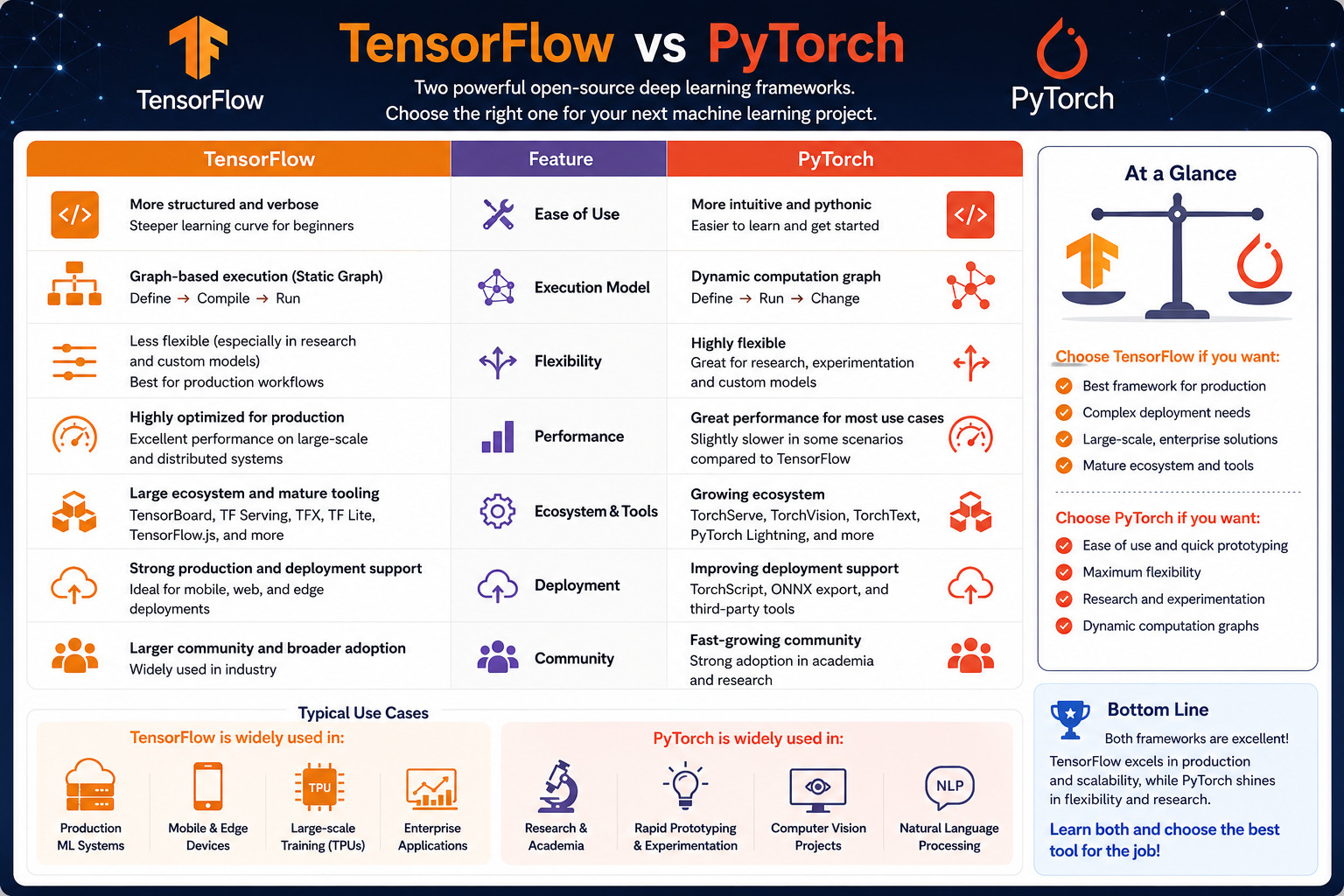
TensorFlow vs PyTorch
| Framework | Strengths |
|---|---|
| TensorFlow | Production deployment, TensorFlow Serving, TensorFlow Lite, enterprise ecosystems |
| PyTorch | Research, rapid experimentation, Hugging Face ecosystem and modern LLM development |
Today, PyTorch dominates cutting-edge AI research and open-source LLM development, while TensorFlow continues to power many enterprise production workloads.
Production Best Practices
- Train using GPUs or TPUs
- Track experiments with MLflow or Weights & Biases
- Version datasets, checkpoints and models
- Use mixed-precision training where appropriate
- Monitor GPU utilization and training cost
- Evaluate fairness, bias and explainability
- Continuously monitor prediction quality after deployment
- Implement rollback strategies for failed model releases
Enterprise Mini Project
Create an end-to-end image classification platform.
- Train a CNN using the CIFAR-10 dataset
- Compare TensorFlow and PyTorch implementations
- Evaluate accuracy and inference latency
- Export the trained model
- Create FastAPI inference endpoints
- Containerize with Docker
- Deploy locally using Docker Compose
- Document architecture and performance metrics
Real-World Engineering Scenarios
| Business Problem | Recommended Architecture |
|---|---|
| Medical Image Diagnosis | CNN / Vision Transformer |
| ChatGPT-style Assistant | Transformer LLM |
| Manufacturing Defect Detection | CNN |
| Speech-to-Text | Transformer |
| Autonomous Driving | CNN + Transformer |
| Enterprise Document Intelligence | Transformer + OCR |
Production Readiness Checklist
- Can I explain why Deep Learning outperforms traditional Machine Learning for unstructured data?
- Do I understand forward propagation and backpropagation conceptually?
- Can I identify when to use CNNs, RNNs or Transformers?
- Can I train, evaluate and export a neural network model?
- Can I deploy inference through an API?
- Do I understand GPU acceleration and model optimization?
- Can I monitor Deep Learning models after deployment?
- Do I understand how Deep Learning leads directly to Large Language Models?
Chapter Summary
Deep Learning is the technological foundation of nearly every modern AI breakthrough. Computer Vision, Natural Language Processing, Generative AI, Large Language Models, AI Agents and multimodal systems all build upon neural network architectures introduced in this chapter. Understanding these principles prepares you for the next stage of your journey—Natural Language Processing and Transformer-based AI systems.
Deep Learning is not the destination—it is the foundation upon which the entire modern AI ecosystem is built.