Principal AI Engineer Roadmap (2026)
Part 04 – Machine Learning Fundamentals
Understand how machines learn from data and how ML powers modern AI systems.
What is Machine Learning?
Machine Learning (ML) enables software to learn patterns from historical data rather than relying solely on manually programmed business rules. Unlike traditional applications where developers explicitly define every decision, ML systems continuously improve by learning from data.
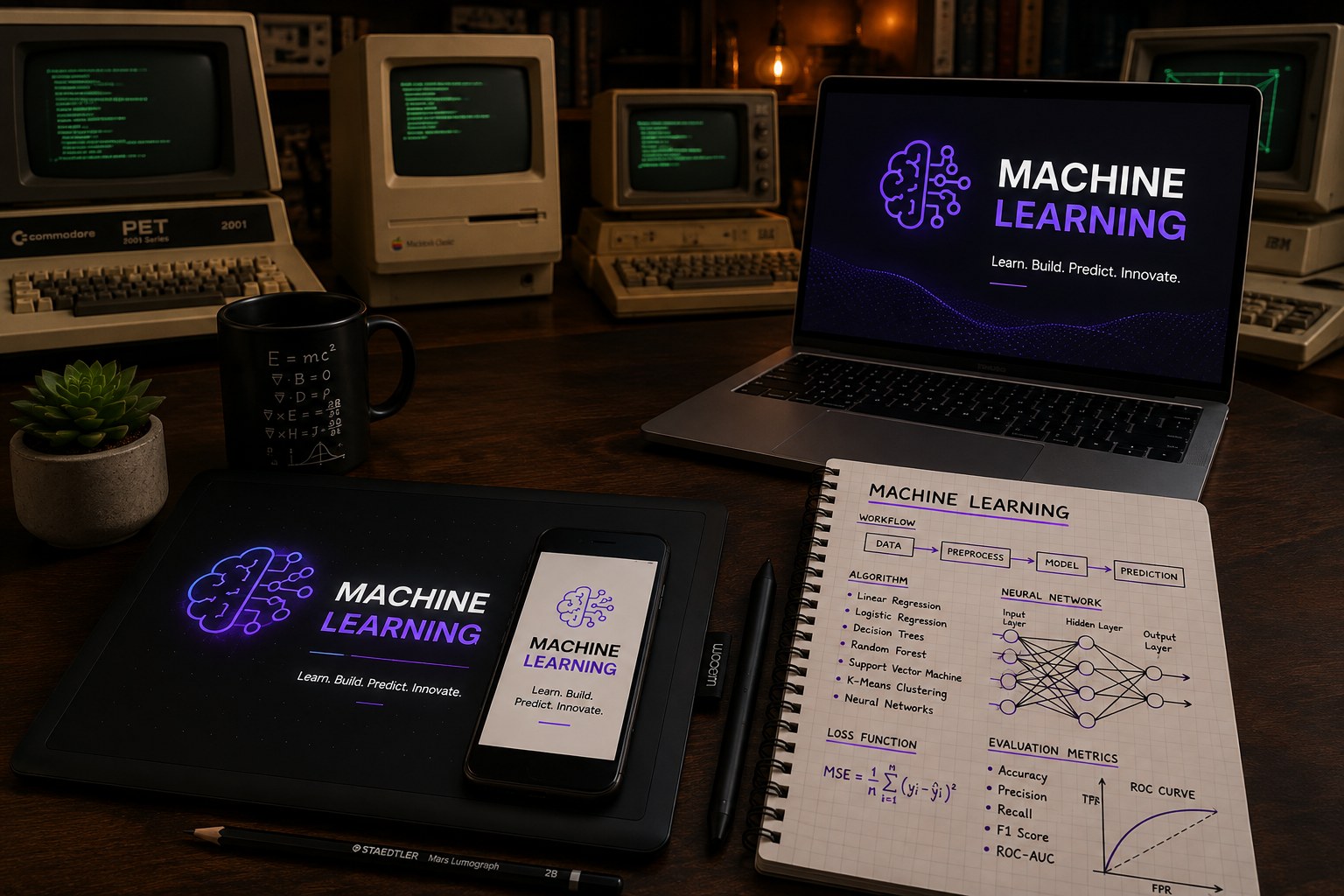
For a Principal AI Engineer, Machine Learning is not simply about selecting algorithms—it is about designing reliable, scalable and explainable systems that transform raw business data into intelligent decisions. This includes everything from data collection and feature engineering to model deployment, monitoring and continuous improvement.
Machine Learning models create business value only when they are deployed, monitored and continuously improved in production.
When Should You Use Machine Learning?
| Business Problem | Traditional Software | Machine Learning |
|---|---|---|
| Invoice Total Calculation | ✅ Best Choice | ❌ Not Required |
| Spam Detection | ⚠ Limited Rules | ✅ Excellent Fit |
| Fraud Detection | ⚠ Difficult | ✅ Ideal |
| Product Recommendation | ❌ Complex Rules | ✅ Excellent Fit |
| Demand Forecasting | ❌ Difficult | ✅ Excellent Fit |
| Image Recognition | ❌ Nearly Impossible | ✅ Standard Solution |
Types of Machine Learning
| Learning Type | Business Goal | Enterprise Examples |
|---|---|---|
| Supervised Learning | Predict known outcomes | Fraud detection, credit scoring, customer churn, demand forecasting |
| Unsupervised Learning | Discover hidden patterns | Customer segmentation, anomaly detection, recommendation systems |
| Semi-Supervised Learning | Use limited labeled data | Medical imaging, document classification |
| Reinforcement Learning | Optimize long-term decisions | Robotics, autonomous systems, resource optimization |
Enterprise Machine Learning Lifecycle
- Define the business problem
- Collect and validate data
- Explore and understand the dataset
- Clean missing or inconsistent data
- Engineer meaningful features
- Split Training, Validation and Test datasets
- Select appropriate algorithms
- Train and evaluate multiple models
- Tune hyperparameters
- Deploy using APIs or batch pipelines
- Monitor prediction quality
- Retrain models using new business data
This lifecycle becomes the foundation for MLOps discussed later in this roadmap.
Popular Machine Learning Algorithms
| Algorithm | Best Used For |
|---|---|
| Linear Regression | Continuous value prediction |
| Logistic Regression | Binary classification |
| Decision Trees | Explainable decision making |
| Random Forest | Robust classification and regression |
| XGBoost | High-performance structured datasets |
| Support Vector Machine | Small and medium-sized datasets |
| K-Means | Customer segmentation |
Model Evaluation
| Problem Type | Common Metrics |
|---|---|
| Classification | Accuracy, Precision, Recall, F1 Score, ROC-AUC |
| Regression | MAE, MSE, RMSE, R² |
| Clustering | Silhouette Score, Davies-Bouldin Index |
Enterprise AI systems rarely optimize for a single metric. Choose evaluation metrics that align with business objectives. For example, fraud detection prioritizes Recall, while spam filtering often prioritizes Precision.
Feature Engineering
Experienced AI engineers know that better data often produces better models than more complex algorithms.
- Handle missing values
- Normalize numerical features
- Encode categorical variables
- Remove outliers
- Create domain-specific features
- Select the most informative features
- Prevent data leakage
High-quality feature engineering frequently delivers larger performance gains than switching to a more sophisticated algorithm.
Scikit-learn Example
Scikit-learn makes it easy to train machine learning models with just a few lines of code. In this example, we create a Linear Regression model, train it using historical data, and then use it to predict values for unseen data.
from sklearn.linear_model import LinearRegression

# Create the model
model = LinearRegression()

# Train the model using training data
model.fit(X_train, y_train)

# Predict values for new data
predictions = model.predict(X_test)
Code Breakdown
- Import the model – The
LinearRegressionclass provides an implementation of the linear regression algorithm. - Create an instance –
LinearRegression()initializes a new model with default parameters. - Train the model –
model.fit(X_train, y_train)learns the relationship between the input features (X_train) and the target values (y_train). - Generate predictions –
model.predict(X_test)uses the trained model to estimate output values for previously unseen data.
Production Best Practices
- Version datasets, features and models
- Prevent training-serving skew
- Prevent data leakage
- Automate retraining pipelines
- Track experiments using MLflow
- Monitor prediction accuracy
- Detect data drift and concept drift
- Implement model rollback strategies
- Log predictions for observability and auditing
Enterprise Mini Project
Build a complete customer churn prediction platform.
- Load a public telecom churn dataset
- Create preprocessing pipelines
- Train Logistic Regression and Random Forest models
- Compare evaluation metrics
- Persist the best model
- Create prediction APIs using FastAPI
- Containerize with Docker
- Document assumptions and business insights
This project forms the first production-ready Machine Learning application in your AI engineering portfolio.
Real-World Engineering Scenarios
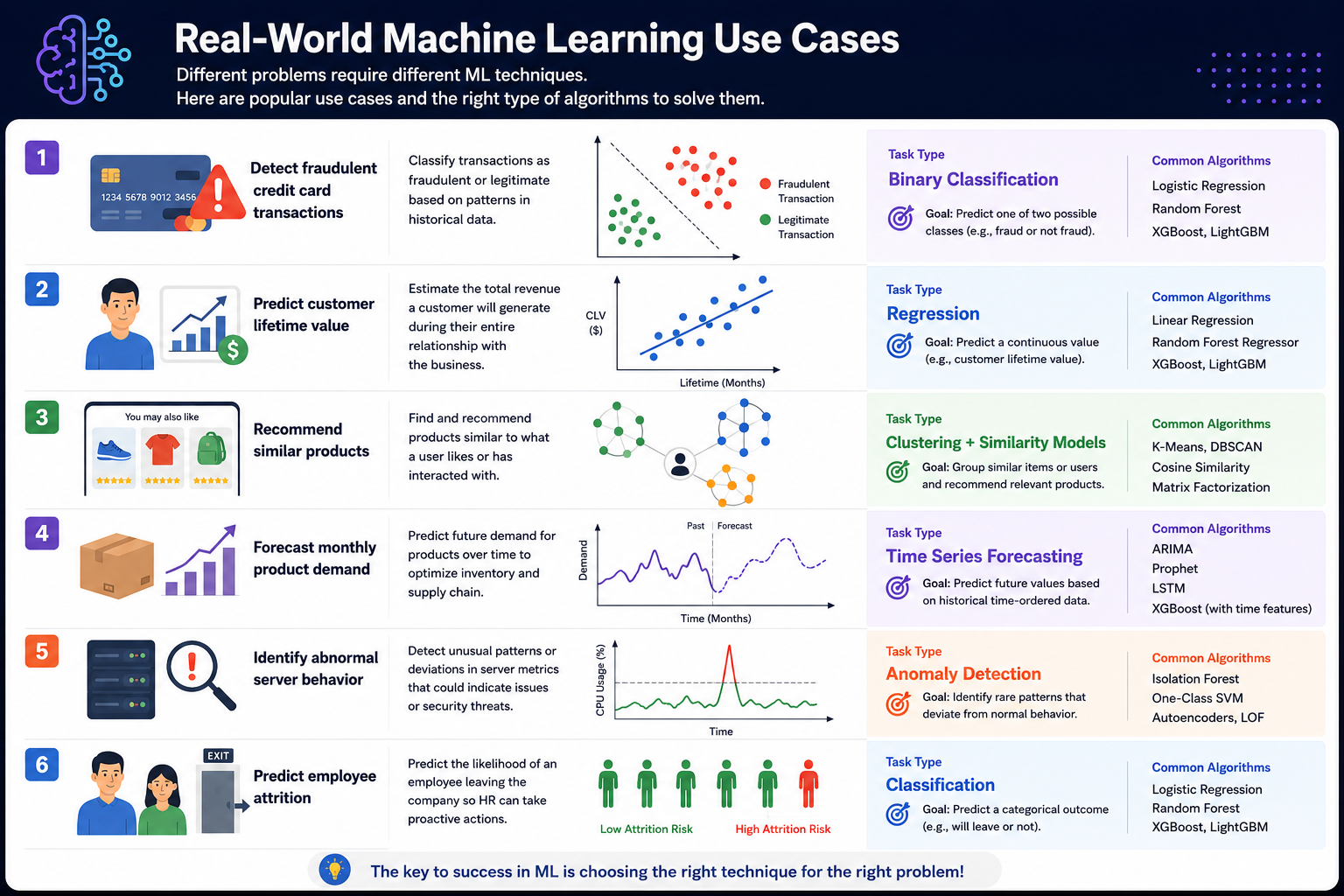
| Business Scenario | Recommended ML Approach |
|---|---|
| Detect fraudulent credit card transactions | Binary Classification |
| Predict customer lifetime value | Regression |
| Recommend similar products | Clustering + Similarity Models |
| Forecast monthly product demand | Time Series Forecasting |
| Identify abnormal server behavior | Anomaly Detection |
| Predict employee attrition | Classification |
Production Readiness Checklist
Before continuing to Deep Learning, ensure you can confidently answer "Yes" to the following:
- Can I identify whether a business problem requires Machine Learning?
- Can I choose an appropriate ML algorithm for structured data?
- Do I understand how to split training, validation and testing datasets?
- Can I evaluate models using business-appropriate metrics?
- Do I understand feature engineering and data leakage?
- Can I expose a trained model through a REST API?
- Can I monitor model performance after deployment?
- Do I understand when a model should be retrained?
Summary
Machine Learning is the foundation upon which modern Artificial Intelligence is built. More importantly, enterprise AI success depends not only on selecting algorithms but on building reliable end-to-end ML systems that integrate software engineering, data engineering and operational excellence. These principles prepare you for Deep Learning, Natural Language Processing and Large Language Models in the chapters ahead.
A Principal AI Engineer is measured not by how many algorithms they know, but by their ability to deliver Machine Learning systems that create measurable business value in production.