Principal AI Engineer Roadmap (2026)
Part 09 – Retrieval-Augmented Generation (RAG)
Learn how Retrieval-Augmented Generation combines enterprise knowledge with LLMs to deliver grounded, accurate responses.
Introduction
Retrieval-Augmented Generation (RAG) is the architecture that transformed Large Language Models from general-purpose assistants into enterprise-ready AI systems. Instead of relying solely on knowledge learned during pretraining, a RAG application retrieves relevant information from trusted external sources and supplies that context to the model before generating a response.
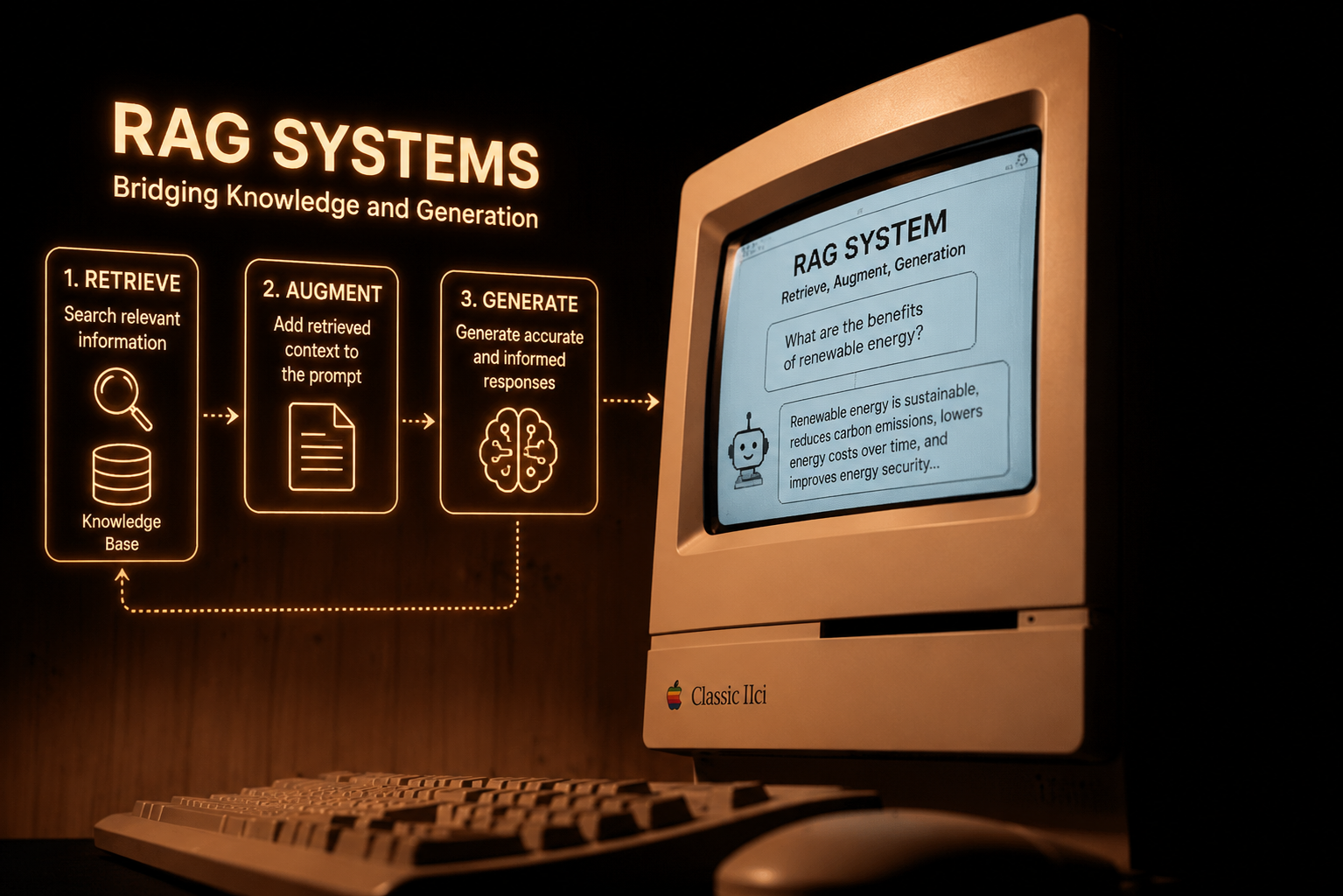
This approach enables AI systems to answer questions using the latest organizational knowledge without retraining or fine-tuning the underlying model. As a result, responses become more accurate, explainable and aligned with enterprise data.
Large Language Models provide reasoning. Retrieval-Augmented Generation provides trusted knowledge.
Why Enterprises Choose RAG
| Challenge | How RAG Solves It |
|---|---|
| Outdated model knowledge | Retrieves the latest enterprise documents. |
| Hallucinations | Grounds answers using trusted sources. |
| Private company information | Uses internal knowledge without retraining. |
| Frequent document updates | Only the knowledge base requires updating. |
| Expensive fine-tuning | Retrieval is significantly faster and cheaper. |
End-to-End RAG Pipeline
- Collect enterprise documents
- Clean and normalize content
- Split documents into meaningful chunks
- Create vector embeddings
- Store embeddings in a Vector Database
- Embed the user's question
- Retrieve the most relevant document chunks
- Optionally re-rank retrieved results
- Construct the final prompt
- Generate a grounded response using the LLM
- Log citations, latency and evaluation metrics
This retrieval pipeline separates enterprise knowledge from the language model itself, allowing organizations to update information without retraining expensive foundation models.
Enterprise RAG Architecture
User
   │
API Gateway
   │
Authentication
   │
Query Processing
   │
Embedding Model
   │
Vector Database
   │
Retriever
   │
Re-Ranker (Optional)
   │
Prompt Builder
   │
Large Language Model
   │
Validation & Guardrails
   │
Application Response
Production RAG systems include authentication, monitoring, logging, caching, security controls and evaluation pipelines in addition to the core retrieval workflow.
Document Chunking Strategies
| Strategy | Best For |
|---|---|
| Fixed Size | Simple text documents |
| Paragraph-Based | Technical documentation |
| Sentence-Based | FAQ systems |
| Semantic Chunking | Enterprise knowledge bases |
| Sliding Window | Long documents with overlapping context |
| Hierarchical Chunking | Books, manuals and structured documents |
Effective chunking has a significant impact on retrieval quality and often matters more than changing the language model itself.
Vector Databases
| Database | Typical Usage |
|---|---|
| FAISS | Local experimentation |
| Chroma | Rapid development |
| Pinecone | Managed enterprise deployments |
| Qdrant | High-performance open-source search |
| Weaviate | Knowledge graph integration |
| Milvus | Large-scale enterprise AI platforms |
Retrieval Techniques
| Technique | Purpose |
|---|---|
| Dense Vector Search | Semantic similarity |
| Keyword Search (BM25) | Exact keyword matching |
| Hybrid Search | Combines semantic and keyword retrieval |
| Metadata Filtering | Restrict search by document attributes |
| Re-Ranking | Improve relevance before prompting |
Most enterprise AI platforms combine hybrid search and re-ranking to maximize retrieval quality.
Python Example
query_embedding = embedding_model.embed(query)

documents = vector_db.search(
    embedding=query_embedding,
    top_k=5
)

context = "\n".join(
    doc.text for doc in documents
)
Production Best Practices
- Use semantic chunking whenever possible.
- Attach metadata to every document chunk.
- Prefer Hybrid Search over vector search alone.
- Apply re-ranking before prompting the LLM.
- Cache frequently requested queries.
- Encrypt sensitive enterprise documents.
- Track retrieval precision and recall.
- Log citations for explainability and auditing.
- Monitor latency, token usage and retrieval quality.
- Continuously refresh embeddings as knowledge changes.
Enterprise Mini Project
Build an Enterprise Knowledge Assistant.
- Ingest PDF, Word and Markdown documents.
- Create semantic embeddings.
- Store vectors in Qdrant or Pinecone.
- Implement Hybrid Search.
- Add document citations.
- Support user authentication.
- Expose FastAPI endpoints.
- Containerize using Docker.
- Deploy on Kubernetes.
This project becomes the enterprise knowledge layer that powers the autonomous AI Agents built in the next chapter.
Production Readiness Checklist
- Can I explain why RAG is preferred over fine-tuning?
- Do I understand embeddings and semantic search?
- Can I choose an appropriate chunking strategy?
- Do I know when to use Hybrid Search?
- Can I evaluate retrieval quality separately from LLM quality?
- Do I understand metadata filtering and document security?
- Can I build a production-ready RAG pipeline?
- Am I ready to build AI Agents that reason over enterprise knowledge?
Chapter Summary
Retrieval-Augmented Generation is the architectural foundation of enterprise AI. By combining semantic retrieval with Large Language Models, organizations can build assistants that reason using accurate, current and trusted business knowledge while significantly reducing hallucinations. In the next chapter, you'll extend this architecture by introducing AI Agents that can reason, retrieve information, invoke external tools and autonomously execute multi-step business workflows.
An LLM answers questions. RAG answers them using trusted enterprise knowledge. AI Agents take the next step by turning that knowledge into intelligent actions.