Principal AI Engineer Roadmap (2026)
Part 10 – AI Agents & Agentic AI Systems
Build autonomous AI systems capable of reasoning, planning, using tools and collaborating to accomplish complex tasks.
From Chatbots to Autonomous AI Systems
Large Language Models can understand, reason and generate content, but by themselves they are passive—they respond only to the prompt they receive. Enterprise applications, however, often require AI systems that can plan, retrieve information, interact with business applications, make decisions, validate results and execute multi-step workflows. This is where AI Agents become essential.
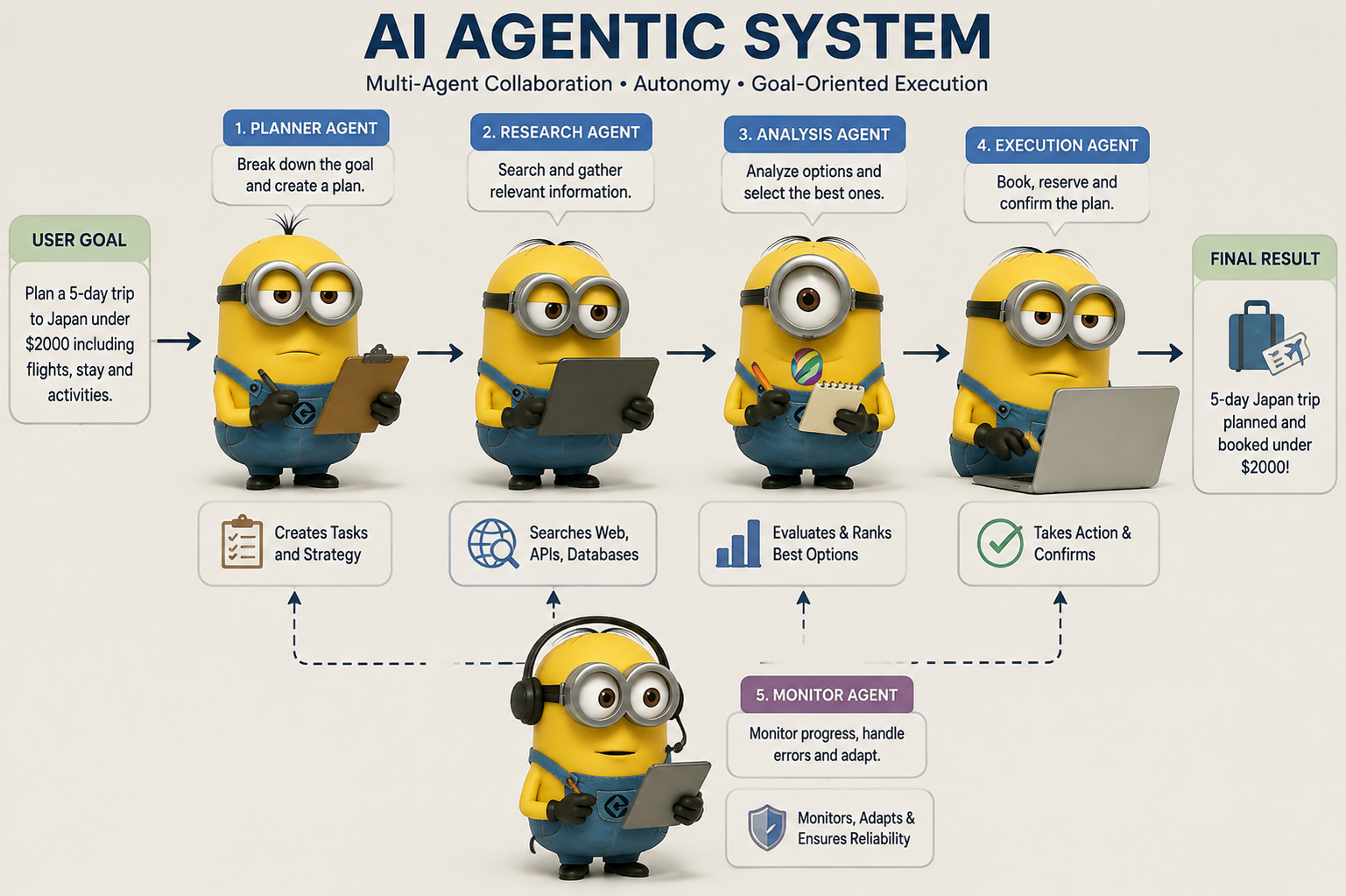
An AI Agent combines the reasoning capabilities of an LLM with memory, planning, external tools and business logic. Rather than producing a single response, an agent continuously evaluates its progress toward a goal, deciding when to retrieve additional knowledge, invoke APIs, execute code or ask the user for clarification.
Core Architecture of an AI Agent
| Component | Responsibility |
|---|---|
| Large Language Model | Reasoning, planning and decision making. |
| Planner | Breaks complex objectives into smaller executable tasks. |
| Memory | Maintains conversation history, long-term knowledge and user context. |
| Retriever | Searches enterprise documents using RAG when additional knowledge is required. |
| Tools | REST APIs, databases, cloud services, monitoring platforms, GitHub, Jira and business applications. |
| Executor | Runs tool calls, validates outputs and manages retries. |
| Guardrails | Applies security policies, permission checks and response validation. |
| Observability | Captures traces, logs, latency, token usage and execution metrics. |
Typical Agent Workflow
- Receive the user's objective.
- Analyze the task and determine whether additional information is required.
- Create an execution plan.
- Retrieve enterprise knowledge through RAG if necessary.
- Select appropriate tools or APIs.
- Execute actions and validate responses.
- Revise the plan if execution fails or new information becomes available.
- Generate a verified response with supporting evidence.
- Log the complete execution for auditing and monitoring.
Unlike traditional applications that follow predefined workflows, AI agents dynamically determine the next action based on the current context and intermediate results.
Memory in Agentic Systems
| Memory Type | Purpose |
|---|---|
| Short-Term Memory | Maintains the current conversation and reasoning context. |
| Long-Term Memory | Stores user preferences, historical interactions and learned knowledge. |
| Semantic Memory | Retrieves relevant enterprise documents using vector databases. |
| Working Memory | Tracks intermediate decisions while solving complex problems. |
Well-designed memory systems reduce repetitive prompts, improve personalization and enable long-running enterprise workflows.
Agent Design Patterns
| Pattern | Typical Enterprise Usage |
|---|---|
| Single Agent | Knowledge assistants, document search, FAQ systems. |
| Supervisor–Worker | Complex orchestration where one agent delegates specialized tasks. |
| Specialist Agents | Dedicated coding, testing, security, documentation or analytics agents. |
| Multi-Agent Collaboration | Large enterprise workflows requiring coordination between multiple AI systems. |
| Human-in-the-Loop | High-risk workflows requiring managerial approval before execution. |
Popular Agent Frameworks
- LangGraph
- CrewAI
- Microsoft AutoGen
- OpenAI Agents SDK
- Semantic Kernel
- LlamaIndex Workflows
Each framework provides abstractions for planning, tool execution, memory management and workflow orchestration. Principal AI Engineers should evaluate these frameworks based on scalability, observability, extensibility and enterprise security requirements rather than popularity alone.
Model Context Protocol (MCP)
Model Context Protocol (MCP) provides a standardized way for AI applications to securely connect with external tools, databases, APIs and business systems. Instead of building custom integrations for every application, MCP enables reusable, standardized connectors that simplify enterprise AI development.
Enterprise Agent Architecture
User
   │
API Gateway
   │
Authentication
   │
AI Agent
   │
Planner
   │
───────────────
│     │      │
RAG  APIs  Tools
│     │      │
───────────────
   │
Validation & Guardrails
   │
Monitoring & Logging
   │
Final Response
Python Concept
def search_documents(query):
    return retriever.search(query)

def create_ticket(summary):
    return jira.create(summary)

# The agent decides
# which function to call,
# in what order,
# based on the user's goal.
Enterprise Engineering Best Practices
- Grant agents only the minimum permissions required (Principle of Least Privilege).
- Validate every tool invocation before execution.
- Require human approval for financial, legal or production-impacting actions.
- Implement retry logic, fallbacks and timeout handling for external tools.
- Log every reasoning step, tool call and decision for auditing.
- Track latency, token consumption, tool success rate and overall task completion.
- Continuously evaluate agents using benchmark tasks before production deployment.
Capstone Mini Project
Build an Enterprise DevOps AI Agent capable of:
- Answering engineering questions using Retrieval-Augmented Generation.
- Searching internal documentation.
- Querying monitoring systems for production incidents.
- Generating Jira-ready incident reports.
- Drafting root cause analyses.
- Creating deployment summaries.
- Escalating critical issues to human engineers when confidence is low.
This project combines Prompt Engineering, RAG, tool calling, APIs, FastAPI, Docker and observability into a production-style enterprise AI system.
Principal AI Engineer Design Scenarios
- Design an AI agent that can diagnose production incidents by combining monitoring tools, internal documentation and ticket history.
- When would you choose a single autonomous agent over a multi-agent architecture? What trade-offs influence your decision?
- How would you prevent an AI agent from executing destructive or unauthorized operations in a production environment?
- Design an observability strategy for AI agents. Which metrics, logs and traces would you collect to measure reliability and business impact?
- Your agent depends on multiple external APIs, one of which becomes unavailable. How would you design retries, fallbacks and graceful degradation?
- How would you evaluate whether an enterprise AI agent is actually improving operational efficiency rather than simply generating plausible responses?
Chapter Summary
AI Agents represent the next evolution of enterprise AI by extending Large Language Models with planning, memory, retrieval and tool execution. Designing reliable agentic systems requires much more than prompt engineering—it demands strong software architecture, security, observability and production engineering practices. These capabilities distinguish Principal AI Engineers who build enterprise-scale AI platforms from developers who simply integrate LLM APIs.