Principal AI Engineer Roadmap (2026)
Part 14 – AI System Design & Enterprise Architecture
Design scalable, resilient, secure and cost-effective enterprise AI platforms capable of serving millions of requests.
Thinking Like a Principal AI Engineer
At the Principal level, success is measured less by the ability to build individual AI models and more by the ability to design resilient, secure and scalable AI platforms that serve thousands of users and integrate seamlessly with enterprise systems.
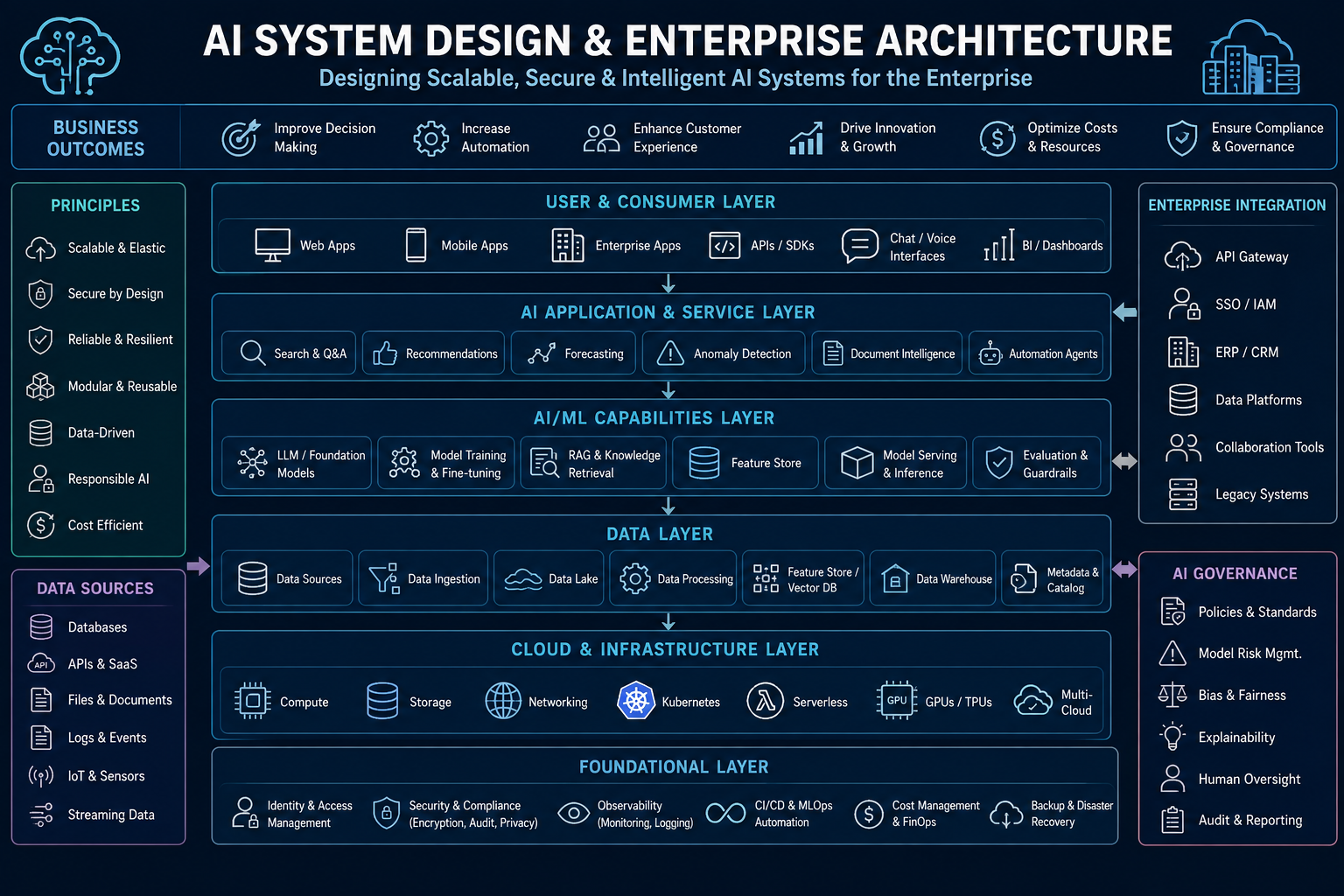
Enterprise AI architecture is a multidisciplinary engineering challenge involving distributed systems, cloud infrastructure, networking, security, data engineering, MLOps, LLMOps and software architecture. Every architectural decision impacts scalability, reliability, cost, compliance and user experience.
Core Architecture Principles
| Principle | Why It Matters |
|---|---|
| Loose Coupling | Independent services can evolve without impacting others. |
| Scalability | Support increasing users, documents and AI workloads. |
| High Availability | Ensure AI services remain operational during failures. |
| Security by Design | Protect enterprise data throughout the AI lifecycle. |
| Observability | Rapidly identify failures, latency and model issues. |
| Automation | Enable continuous deployment with minimal manual effort. |
| Cost Optimization | Deliver AI capabilities while controlling infrastructure and token costs. |
Choosing the Right Architecture
| Architecture | Best For | Trade-offs |
|---|---|---|
| Monolith | Prototypes and small internal tools | Simple but difficult to scale independently |
| Microservices | Enterprise AI platforms | Excellent scalability with increased operational complexity |
| Event-Driven | Streaming, asynchronous AI pipelines | High throughput with eventual consistency |
| Serverless | Low-volume inference and automation | Minimal operations but limited execution time |
| Hybrid Cloud | Regulated industries | Balances compliance with cloud scalability |
Enterprise AI Reference Architecture
                Users
                  │
            CDN / Load Balancer
                  │
            API Gateway
                  │
      Authentication (OAuth/JWT)
                  │
            AI Gateway
                  │
 ┌──────────────────────────────────┐
 │ Prompt Service                   │
 │ RAG Service                      │
 │ Agent Orchestrator               │
 │ Model Router                     │
 │ Guardrails & Moderation          │
 └──────────────────────────────────┘
        │         │          │
        │         │          │
 Vector DB   SQL/NoSQL   Object Storage
        │
 Message Queue / Event Bus
        │
 Kubernetes Cluster
        │
 Monitoring • Logs • Traces • Alerts
This architecture separates responsibilities into independent services, making scaling, maintenance and future enhancements significantly easier.
Design Decisions Every Architect Makes
| Question | Typical Considerations |
|---|---|
| Which LLM should handle this request? | Accuracy, latency, token cost and context length. |
| Should this use RAG? | Dynamic enterprise knowledge versus static model knowledge. |
| Should inference be synchronous? | User experience versus long-running background tasks. |
| How should data be stored? | SQL, NoSQL, Object Storage and Vector Databases. |
| How will failures be handled? | Retries, circuit breakers, fallbacks and graceful degradation. |
Scalability & Performance
Large-scale AI platforms must be designed to handle unpredictable workloads while maintaining low response times.
- Horizontal scaling with Kubernetes
- Load balancing across inference services
- Autoscaling based on CPU, GPU and queue depth
- Embedding and response caching
- Model routing to smaller or larger LLMs based on task complexity
- Streaming responses to improve perceived performance
- Asynchronous processing for long-running AI workflows
Enterprise Security
AI platforms introduce new attack surfaces beyond traditional applications. Security should be built into every layer of the architecture.
- Zero Trust networking
- Identity and Access Management (IAM)
- Role-Based Access Control (RBAC)
- Secret management using Vault or cloud secret services
- Encryption in transit and at rest
- Prompt injection protection
- Sensitive data masking
- Audit logging and compliance reporting
Reliability & Fault Tolerance
- Multi-zone deployments
- Automatic retries with exponential backoff
- Circuit breaker pattern
- Health checks and self-healing containers
- Graceful degradation when AI services fail
- Disaster recovery planning
- Backup and restore strategies
A resilient AI platform continues serving users even when individual services fail.
Observability & Operations
| Area | Metrics |
|---|---|
| Infrastructure | CPU, GPU, Memory, Storage |
| Application | Latency, Throughput, Error Rate |
| LLM Services | Token Usage, Context Size, Hallucination Rate |
| RAG | Retrieval Accuracy, Citation Quality, Search Latency |
| Business | User Satisfaction, Adoption, Cost per Request |
System Design Case Study
Your architecture should address:
- Authentication and authorization
- Multi-tenant security
- Document ingestion pipelines
- RAG-based knowledge retrieval
- Agent orchestration for workflows
- Model routing across multiple LLMs
- High availability across regions
- Observability, monitoring and alerting
- Cost optimization and token budgeting
This mirrors the type of architecture discussions commonly encountered in Staff and Principal engineering interviews.
Hands-on Capstone
Create the architecture for a production-ready Enterprise AI Platform that includes:
- API Gateway
- Authentication service
- Prompt management service
- RAG pipeline
- AI Agent orchestration
- Vector database
- Message queue
- Kubernetes deployment
- CI/CD pipelines
- Prometheus and Grafana monitoring
- Disaster recovery documentation
- Architecture diagrams and deployment guide
Principal AI Engineer System Design Interview
Rather than memorizing answers, practice explaining the architectural trade-offs behind your decisions. Typical discussion topics include:
- Designing a multi-region enterprise RAG platform.
- Choosing between proprietary and open-weight LLMs.
- Reducing latency while maintaining response quality.
- Scaling AI inference for millions of daily requests.
- Designing fault-tolerant AI services using retries, queues and circuit breakers.
- Balancing security, compliance, observability and operational cost.
- Architecting AI platforms that support multiple business domains through shared services.
Chapter Summary
System design is where software engineering, cloud architecture and Artificial Intelligence converge. Principal AI Engineers are expected to build platforms—not isolated models—that are scalable, resilient, secure and maintainable. Mastering architectural trade-offs, distributed systems and operational excellence is one of the defining skills that separates Principal Engineers from senior developers.