Principal AI Engineer Roadmap (2026)
Part 11 – AI Engineering with Python, FastAPI & APIs
Build secure, scalable and production-ready AI services using Python, FastAPI and REST APIs.
Building Enterprise AI Services
Artificial Intelligence models rarely operate in isolation. In production environments they are exposed through APIs that integrate with web applications, mobile apps, enterprise software, business workflows and other AI services. As a Principal AI Engineer, your responsibility extends beyond writing model inference code—you must design secure, scalable and observable AI services that reliably serve thousands or even millions of requests.
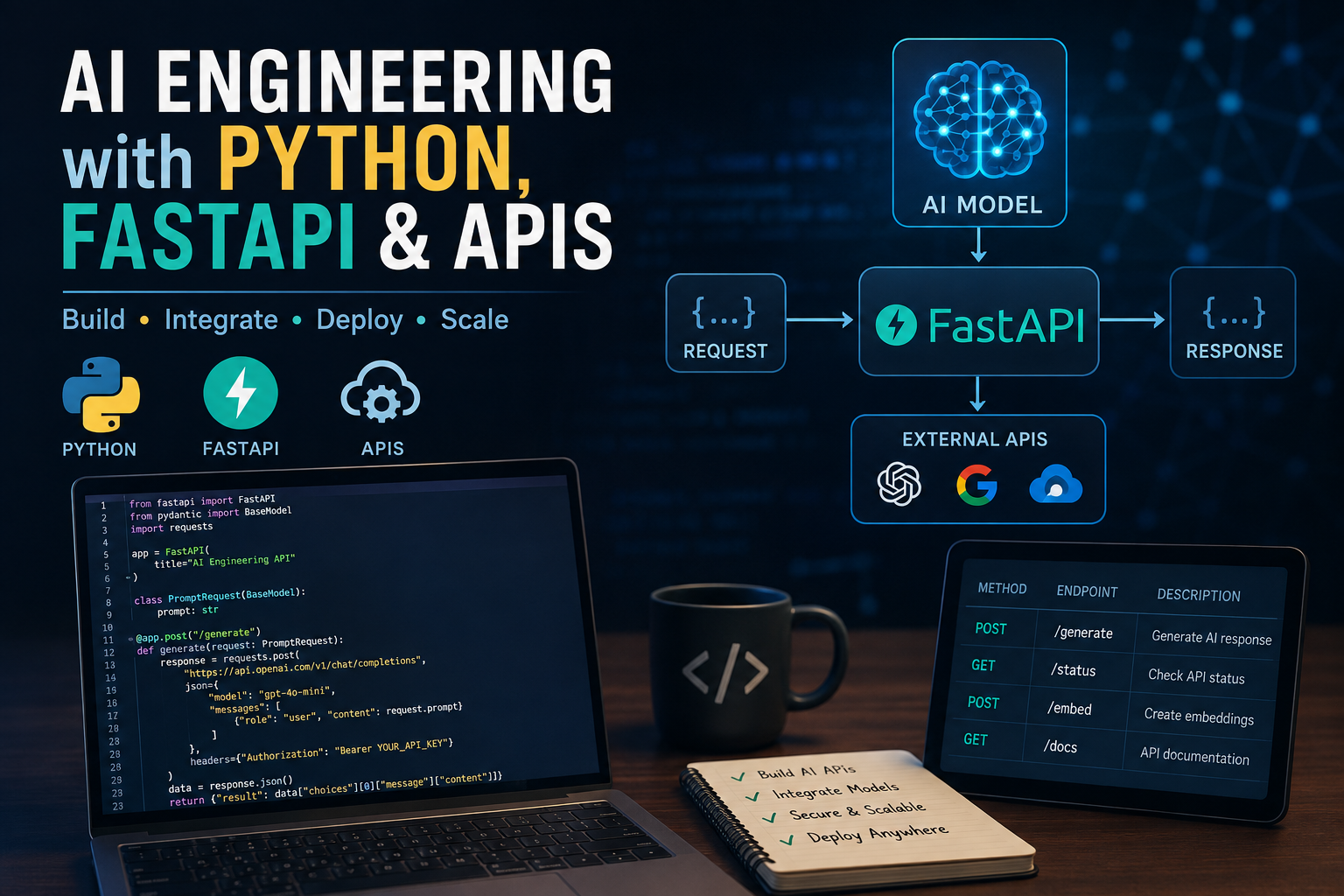
FastAPI has emerged as one of the leading Python frameworks for AI engineering because it combines high performance, asynchronous programming, automatic OpenAPI documentation and strong data validation. Together with Python's AI ecosystem, FastAPI enables rapid development of production-ready AI platforms.
Essential Technologies
| Technology | Role in AI Platforms |
|---|---|
| Python | Core programming language for AI, automation and backend services. |
| FastAPI | High-performance REST APIs for model inference and AI workflows. |
| Pydantic | Request validation, serialization and schema enforcement. |
| Uvicorn / Gunicorn | Production-grade ASGI application servers. |
| HTTPX | Asynchronous communication with external APIs and LLM providers. |
| SQLAlchemy | Relational database access and ORM. |
| Alembic | Database versioning and schema migrations. |
| Redis | Caching, rate limiting and background task coordination. |
Reference Enterprise Architecture
                    Client Applications
             Web • Mobile • Internal Systems
                        │
                 API Gateway / Load Balancer
                        │
         Authentication • Rate Limiting • WAF
                        │
                 FastAPI AI Microservice
      ┌─────────────────────────────────────────┐
      │ Authentication                          │
      │ Request Validation                      │
      │ Prompt Builder                          │
      │ Business Logic                          │
      │ LLM / ML Inference                      │
      │ Vector Database                         │
      │ SQL / NoSQL Database                    │
      │ Cache (Redis)                           │
      │ Logging & Metrics                       │
      └─────────────────────────────────────────┘
                        │
             JSON / Streaming Response
Modern AI applications are typically implemented as microservices, allowing independent deployment, scaling and lifecycle management of inference, retrieval and business logic components.
FastAPI Fundamentals
from fastapi import FastAPI

app = FastAPI()

@app.get("/health")
def health():
    return {"status":"UP"}

@app.post("/summarize")
def summarize(request: dict):
    return {
        "summary": "Generated summary"
    }
FastAPI automatically generates OpenAPI documentation, validates request payloads and provides interactive Swagger documentation, making API development significantly faster than traditional Python frameworks.
Designing Production APIs
- Design APIs around business capabilities rather than AI models.
- Version every public API (/v1, /v2) to support backward compatibility.
- Validate every request using strongly typed Pydantic models.
- Return standardized JSON error responses.
- Support pagination, filtering and sorting for search APIs.
- Use asynchronous endpoints when calling external AI services.
- Keep inference services stateless to simplify horizontal scaling.
- Document every endpoint through OpenAPI and Swagger UI.
Securing AI APIs
| Security Area | Recommended Practice |
|---|---|
| Authentication | OAuth2, JWT or enterprise SSO. |
| Authorization | Role-Based Access Control (RBAC). |
| Transport Security | HTTPS and TLS everywhere. |
| Secrets | Store credentials in Vault or cloud secret managers. |
| Rate Limiting | Prevent abuse and excessive token consumption. |
| Input Validation | Reject malformed or malicious requests. |
| Prompt Security | Sanitize inputs to mitigate prompt injection attacks. |
Observability & Production Monitoring
Unlike traditional APIs, AI services require monitoring of both software performance and model behavior.
- Structured application logs.
- Distributed tracing using OpenTelemetry.
- Prometheus metrics and Grafana dashboards.
- Health and readiness endpoints.
- Token usage and inference latency.
- Request throughput and error rates.
- LLM cost monitoring.
- Model accuracy and response quality metrics.
- Prompt and response auditing for enterprise governance.
Testing Strategy
| Test Type | Purpose |
|---|---|
| Unit Testing | Validate business logic. |
| API Testing | Verify endpoint behavior. |
| Integration Testing | Test databases, vector stores and external services. |
| Load Testing | Measure scalability and throughput. |
| Security Testing | Validate authentication and authorization. |
| LLM Evaluation | Measure response quality and hallucination rates. |
Automate these tests within CI/CD pipelines to ensure every deployment meets quality and reliability standards.
Capstone Mini Project
Build an Enterprise AI Knowledge API using FastAPI that includes:
- User authentication using JWT.
- Document upload endpoints.
- Vector embedding generation.
- Retrieval-Augmented Generation (RAG).
- Streaming LLM responses.
- Request validation with Pydantic.
- Structured logging and Prometheus metrics.
- Docker deployment.
- Automated API tests.
- Swagger documentation.
This project closely resembles the architecture used in production enterprise AI platforms.
Principal AI Engineer Design Scenarios
- Design a FastAPI-based AI platform capable of serving thousands of concurrent inference requests with minimal latency.
- How would you secure an AI API that accesses proprietary enterprise documents and customer data?
- Describe how you would version APIs while maintaining backward compatibility for existing clients.
- Your AI endpoint experiences a sudden increase in latency after deploying a new model. How would you investigate and resolve the issue?
- How would you monitor model performance, token usage, operational cost and response quality in production?
- Design a deployment strategy that enables zero-downtime releases for enterprise AI microservices.
Chapter Summary
Enterprise AI systems are delivered through reliable, secure and scalable APIs rather than standalone notebooks. Mastering FastAPI, asynchronous programming, API design, security, testing and observability enables you to transform AI models into production-ready services. These engineering practices form the foundation for the next chapters on cloud-native deployment, Kubernetes, MLOps and operating AI platforms at enterprise scale.