Principal AI Engineer Roadmap (2026)
Part 13 – MLOps, LLMOps & Production AI Operations
Build repeatable, observable and production-ready AI delivery pipelines covering machine learning models and Large Language Model applications.
From Prototype to Production
Building an accurate AI model is only the beginning. Enterprise AI systems must be reproducible, scalable, observable, secure and continuously improving. MLOps (Machine Learning Operations) applies DevOps principles to the complete machine learning lifecycle, while LLMOps extends those practices to Generative AI applications by introducing prompt management, retrieval evaluation, guardrails and cost optimization.
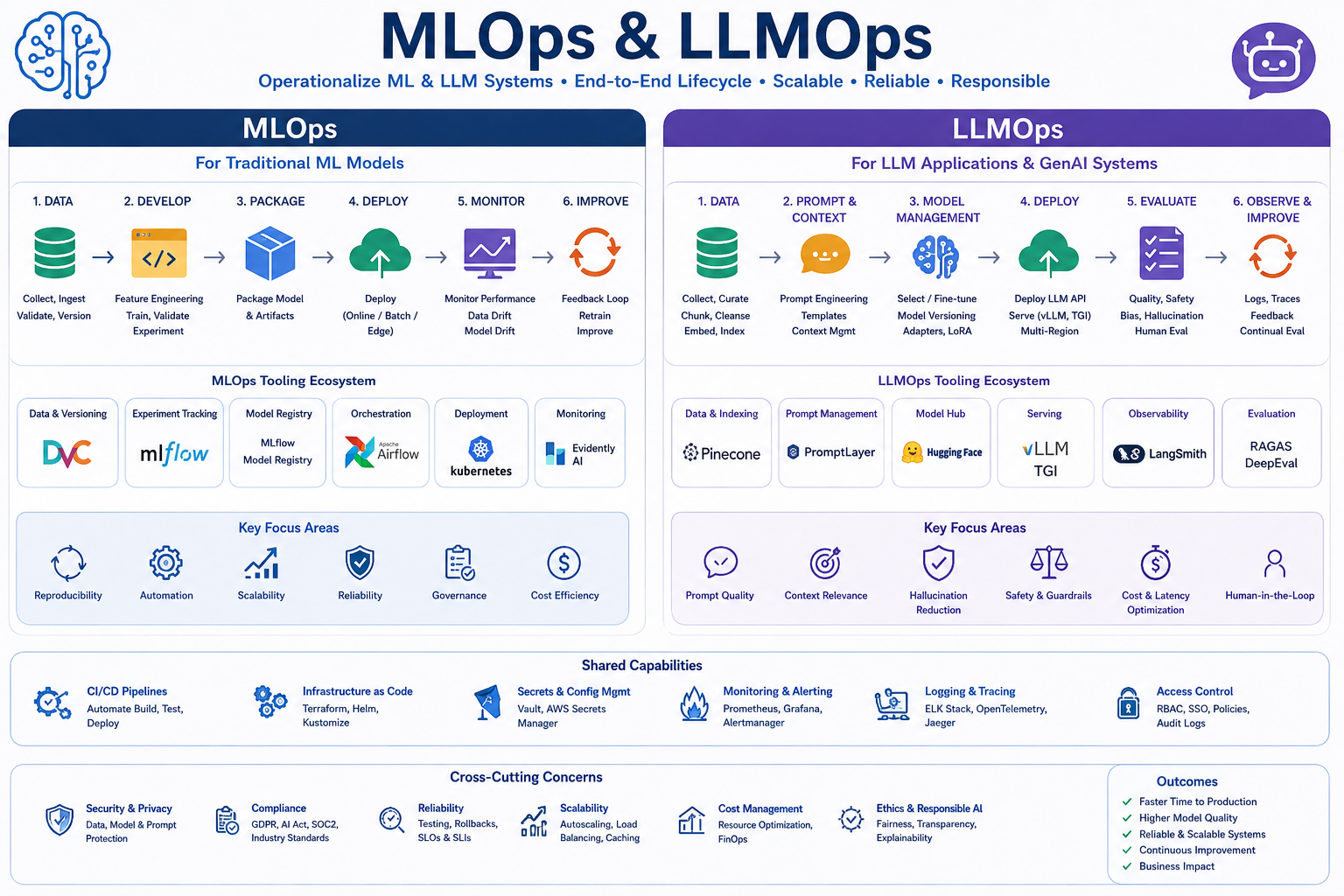
MLOps vs LLMOps
| Capability | MLOps | LLMOps |
|---|---|---|
| Primary Focus | Machine Learning models | LLM-powered applications |
| Versioning | Models & datasets | Models, prompts, embeddings & retrieval pipelines |
| Evaluation | Accuracy, Precision, Recall | Faithfulness, relevance, hallucination rate, safety |
| Deployment | Model serving | LLMs, RAG, agents and tool integrations |
| Monitoring | Model drift & latency | Token usage, prompt quality, retrieval quality, cost and user feedback |
| Operations | Retraining pipelines | Prompt iteration, knowledge base updates and guardrail tuning |
Enterprise AI Delivery Pipeline
- Collect and validate training or enterprise knowledge data
- Track datasets, prompts and experiments
- Train, fine-tune or integrate foundation models
- Evaluate quality using benchmark datasets
- Register approved model artifacts
- Containerize inference services
- Deploy using automated CI/CD pipelines
- Monitor production health, latency, accuracy and costs
- Continuously improve using production feedback and retraining
The objective is not simply deploying a model—it is establishing a repeatable engineering process where every release is measurable, reversible and auditable.
Core Platform Components
| Component | Purpose |
|---|---|
| Git | Source control for code, prompts and infrastructure |
| MLflow / Weights & Biases | Experiment tracking and model lineage |
| Feature Store | Reusable and consistent features across training and inference |
| Model Registry | Versioning, approvals and lifecycle management |
| Docker & Kubernetes | Portable deployment and orchestration |
| CI/CD Pipeline | Automated testing and deployment |
| Prometheus & Grafana | Operational monitoring and alerting |
| Vector Database | Enterprise knowledge retrieval for RAG systems |
Reference Production Architecture
Developer
     │
     ▼
 Git Repository
     │
     ▼
 CI/CD Pipeline
     │
 ┌──────────────┐
 │ Automated    │
 │ Tests        │
 └──────────────┘
     │
     ▼
 Docker Image
     │
     ▼
 Kubernetes
     │
 ┌──────────────┐
 │ FastAPI API  │
 └──────────────┘
     │
 ┌──────────────┐
 │ LLM / Model  │
 └──────────────┘
     │
 Vector DB • SQL • Cache
     │
 Prometheus • Grafana • Logs • Traces
This architecture represents a typical enterprise AI platform capable of serving both predictive machine learning models and modern RAG-based Generative AI applications.
Production Monitoring
Monitoring AI applications extends far beyond infrastructure health. Successful teams continuously evaluate both technical performance and business outcomes.
| Category | Key Metrics |
|---|---|
| Infrastructure | CPU, GPU, Memory, Disk, Network |
| Application | Latency, Throughput, Error Rate, Availability |
| Machine Learning | Accuracy, Precision, Recall, Drift Detection |
| LLM Applications | Hallucination Rate, Faithfulness, Retrieval Precision, Token Usage |
| Business | User Satisfaction, Task Success Rate, Operational Cost |
PromptOps & Continuous Evaluation
Modern LLM applications require the same engineering rigor as software development. Prompt templates should be version-controlled, automatically tested and evaluated before deployment.
- Version prompts alongside application code
- Maintain reusable prompt libraries
- Benchmark every prompt change
- Perform A/B testing for prompt variations
- Measure correctness, faithfulness and relevance
- Track retrieval quality separately from LLM quality
- Use human evaluation for high-impact applications
Governance, Security & Responsible AI
Enterprise AI introduces new governance requirements that extend beyond traditional software engineering. Every production system should incorporate security, compliance and responsible AI practices from the beginning.
- Role-Based Access Control (RBAC)
- PII detection and automated masking
- Complete audit trails
- Model approval workflows
- Prompt and model version history
- Content safety filters
- Human approval for critical decisions
- Compliance with organizational and regulatory policies
Hands-on Capstone Project
Build a production-ready Enterprise AI platform that includes:
- FastAPI inference services
- Docker containerization
- Kubernetes deployment
- MLflow experiment tracking
- Prompt version management
- RAG with a vector database
- Prometheus metrics
- Grafana dashboards
- CI/CD using GitHub Actions
- Automated evaluation pipeline
The finished project should resemble a real enterprise AI platform rather than a standalone machine learning notebook.
Principal AI Engineer Interview Focus
Interviewers at Staff and Principal levels are typically more interested in engineering decisions than definitions. Be prepared to discuss topics such as:
- Designing an end-to-end MLOps or LLMOps platform for enterprise environments.
- Detecting and responding to model drift, data drift and retrieval quality degradation.
- Rolling back a failed model deployment while maintaining service availability.
- Balancing model quality, latency and infrastructure cost for production AI services.
- Implementing governance, auditability and compliance across AI development lifecycles.
- Designing observability dashboards that help operations teams troubleshoot AI systems.
- Evaluating whether a problem should be solved using traditional ML, RAG, fine-tuning or AI agents.
Chapter Summary
MLOps and LLMOps transform AI experimentation into enterprise-grade engineering. A Principal AI Engineer is expected to build platforms that continuously deliver reliable, secure and measurable AI capabilities—not just accurate models. Mastering automation, observability, governance and continuous evaluation is what separates production AI systems from research prototypes.