Principal AI Engineer Roadmap (2026)
Part 12 – Docker, Kubernetes & Cloud-Native AI Deployment
Learn how to package, deploy, scale and operate production AI applications using containers and Kubernetes.
Cloud-Native AI Platforms
Enterprise AI applications must operate reliably under unpredictable workloads while maintaining low latency, high availability and strong security. Unlike traditional software, AI services often depend on GPU acceleration, external Large Language Models (LLMs), vector databases, streaming APIs and large-scale data processing. Cloud-native technologies such as Docker and Kubernetes provide the foundation for deploying, scaling and operating these complex AI workloads.
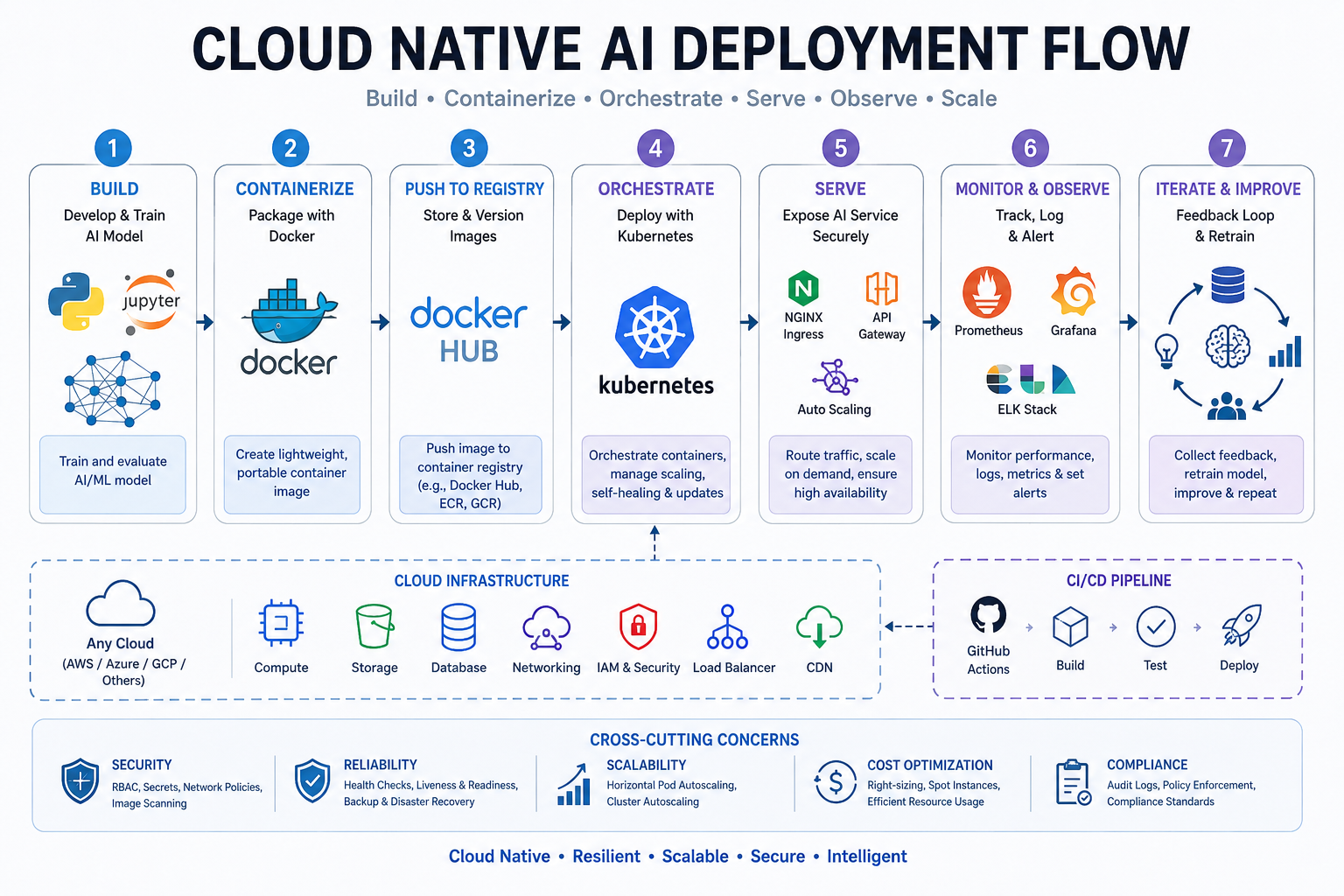
Docker standardizes application packaging, ensuring consistent execution across development, testing and production environments. Kubernetes builds upon containers by automating deployment, scaling, networking, service discovery, self-healing and rolling updates. Together they form the backbone of modern enterprise AI platforms.
Docker Fundamentals
| Concept | Purpose |
|---|---|
| Image | Immutable package containing application code and runtime. |
| Container | Running instance of an image. |
| Dockerfile | Defines how an application image is built. |
| Volumes | Persistent storage outside containers. |
| Networks | Secure communication between services. |
| Multi-stage Builds | Create smaller, optimized production images. |
| Docker Compose | Run multi-container applications locally. |
FROM python:3.12-slim

WORKDIR /app

COPY . .

RUN pip install -r requirements.txt

CMD [
 "uvicorn",
 "app:app",
 "--host","0.0.0.0",
 "--port","8000"
]
Well-designed Docker images improve deployment speed, reduce attack surface and simplify reproducible AI environments.
Kubernetes Core Components
| Component | Enterprise Responsibility |
|---|---|
| Pod | Runs one or more tightly coupled containers. |
| Deployment | Manages replicas, updates and rollback. |
| Service | Provides stable internal networking. |
| Ingress | Routes external HTTP(S) traffic. |
| ConfigMap | Stores application configuration. |
| Secret | Stores credentials and API keys securely. |
| Horizontal Pod Autoscaler | Automatically scales workloads. |
| Persistent Volume | Provides durable storage for stateful services. |
Reference AI Platform Architecture
                  Users
                    │
          Load Balancer / Ingress
                    │
             API Gateway / WAF
                    │
          FastAPI AI Microservices
      ┌─────────────┼──────────────┐
      │             │              │
 RAG Service   AI Agent      ML Inference
      │             │              │
      ├─────────────┼──────────────┤
      │             │              │
 Vector DB     PostgreSQL      Redis
      │
 Object Storage / Documents
      │
 Prometheus • Grafana • OpenTelemetry
Production AI platforms are typically implemented as loosely coupled microservices, allowing inference, retrieval, vector search and business workflows to scale independently.
Deploying AI Workloads
- Deploy inference services independently from business APIs.
- Separate CPU and GPU workloads.
- Scale RAG services independently of LLM inference.
- Use stateless containers whenever possible.
- Keep model artifacts outside container images.
- Store large datasets in object storage rather than container filesystems.
GPU-Based AI Infrastructure
Training modern Deep Learning and Large Language Models requires GPU acceleration. Kubernetes supports GPU scheduling using vendor-specific device plugins, enabling efficient allocation of NVIDIA GPUs across training and inference workloads.
| Workload | Typical Infrastructure |
|---|---|
| Model Training | Multi-GPU clusters |
| Batch Inference | GPU or CPU depending on throughput |
| Real-Time Inference | Low-latency GPU serving |
| Embedding Generation | CPU or lightweight GPU nodes |
| Vector Search | High-memory CPU nodes |
CI/CD & Continuous Delivery
Cloud-native AI platforms require automated deployment pipelines to ensure rapid and reliable releases.
- Build immutable Docker images.
- Scan images for vulnerabilities.
- Run automated unit and integration tests.
- Deploy using Helm charts.
- Perform rolling or blue-green deployments.
- Automatically rollback failed releases.
- Version infrastructure using GitOps principles.
Observability for AI Platforms
Operating AI infrastructure requires visibility into both application performance and model behavior.
- Prometheus metrics.
- Grafana dashboards.
- Distributed tracing using OpenTelemetry.
- Centralized logging with Elasticsearch or Loki.
- Health, readiness and startup probes.
- GPU utilization monitoring.
- Inference latency and throughput.
- Token consumption and operational cost.
- Model accuracy and drift monitoring.
Production Best Practices
- Use immutable container images.
- Run containers as non-root users.
- Store secrets outside container images.
- Apply resource requests and limits.
- Implement Horizontal Pod Autoscaling.
- Use Pod Disruption Budgets for high availability.
- Enable rolling deployments and automatic rollback.
- Continuously monitor infrastructure cost alongside application performance.
Capstone Mini Project
Deploy a production-ready Retrieval-Augmented Generation (RAG) platform consisting of:
- FastAPI API Gateway
- Document ingestion service
- Embedding generation service
- Vector database
- LLM inference service
- Redis cache
- PostgreSQL metadata database
- Docker containers
- Kubernetes deployment with Helm
- Horizontal Pod Autoscaling
- Prometheus and Grafana monitoring
- GitHub Actions CI/CD pipeline
This project closely resembles the deployment architecture used by enterprise AI teams.
Principal AI Engineer Design Scenarios
- Design a Kubernetes platform capable of serving millions of AI inference requests per day while maintaining low latency and high availability.
- Your LLM inference service experiences sudden traffic spikes during business hours. How would you design autoscaling while controlling infrastructure costs?
- How would you separate CPU-intensive services, GPU inference workloads and vector databases within a Kubernetes cluster?
- Describe a zero-downtime deployment strategy for enterprise AI microservices. How would you validate a new model before directing production traffic?
- What monitoring dashboards would you build to observe infrastructure health, inference latency, GPU utilization, token usage and operational cost?
- How would you recover an AI platform after a Kubernetes node failure or cloud region outage while minimizing service disruption?
Chapter Summary
Cloud-native infrastructure enables AI systems to move beyond isolated experiments into highly available, scalable and production-ready platforms. Mastering Docker, Kubernetes, CI/CD, observability and resilient deployment patterns prepares you to operate enterprise AI workloads at scale. These platform engineering skills provide the foundation for the next chapter on MLOps, LLMOps and the continuous lifecycle management of AI systems.