Principal AI Engineer Roadmap (2026)
Part 01 – The Complete Enterprise Learning Path
Reading Time: 15–20 min | Level: Advanced | Series: Part 01
Introduction
Artificial Intelligence (AI) has rapidly evolved from an experimental research domain into a strategic business capability that is transforming every major industry. From intelligent automation and enterprise search to autonomous agents and decision support systems, AI is redefining how organizations build software, optimize operations, and deliver customer experiences. Businesses are no longer seeking engineers who can simply train machine learning models—they need technology leaders capable of designing, deploying, scaling, securing, and governing production-grade AI platforms that deliver measurable business value.
The Principal AI Engineer sits at the intersection of software engineering, Artificial Intelligence, cloud-native architecture, distributed systems, platform engineering, and technical leadership. This role demands expertise beyond model development—it requires designing enterprise AI ecosystems that are secure, scalable, observable, maintainable, and aligned with business objectives. Modern Principal AI Engineers work with Machine Learning, Generative AI, Large Language Models (LLMs), Retrieval-Augmented Generation (RAG), AI Agents, Natural Language Processing (NLP), Python, Docker, Kubernetes, cloud platforms, MLOps, LLMOps, security, governance, and enterprise architecture.
This roadmap is designed to provide a structured, practical learning journey from software engineering fundamentals to enterprise AI leadership. Each chapter builds on the previous one, combining theoretical concepts with real-world implementation strategies, production best practices, architectural patterns, and hands-on projects. Whether your goal is to build AI-powered applications, architect enterprise AI platforms, or lead large-scale AI initiatives, this guide serves as a comprehensive reference for becoming a modern Principal AI Engineer.
Becoming a Principal AI Engineer is not about mastering a single framework—it's about mastering the engineering discipline required to design, build, deploy, operate, and continuously improve trustworthy, scalable AI systems for the enterprise.
Core Technology Landscape
Enterprise AI combines multiple engineering disciplines rather than relying on a single technology. A successful Principal AI Engineer understands how these technologies work together to create reliable, intelligent, cloud-native applications capable of serving millions of users while maintaining security, performance, and operational excellence.
Who Should Read This Guide?
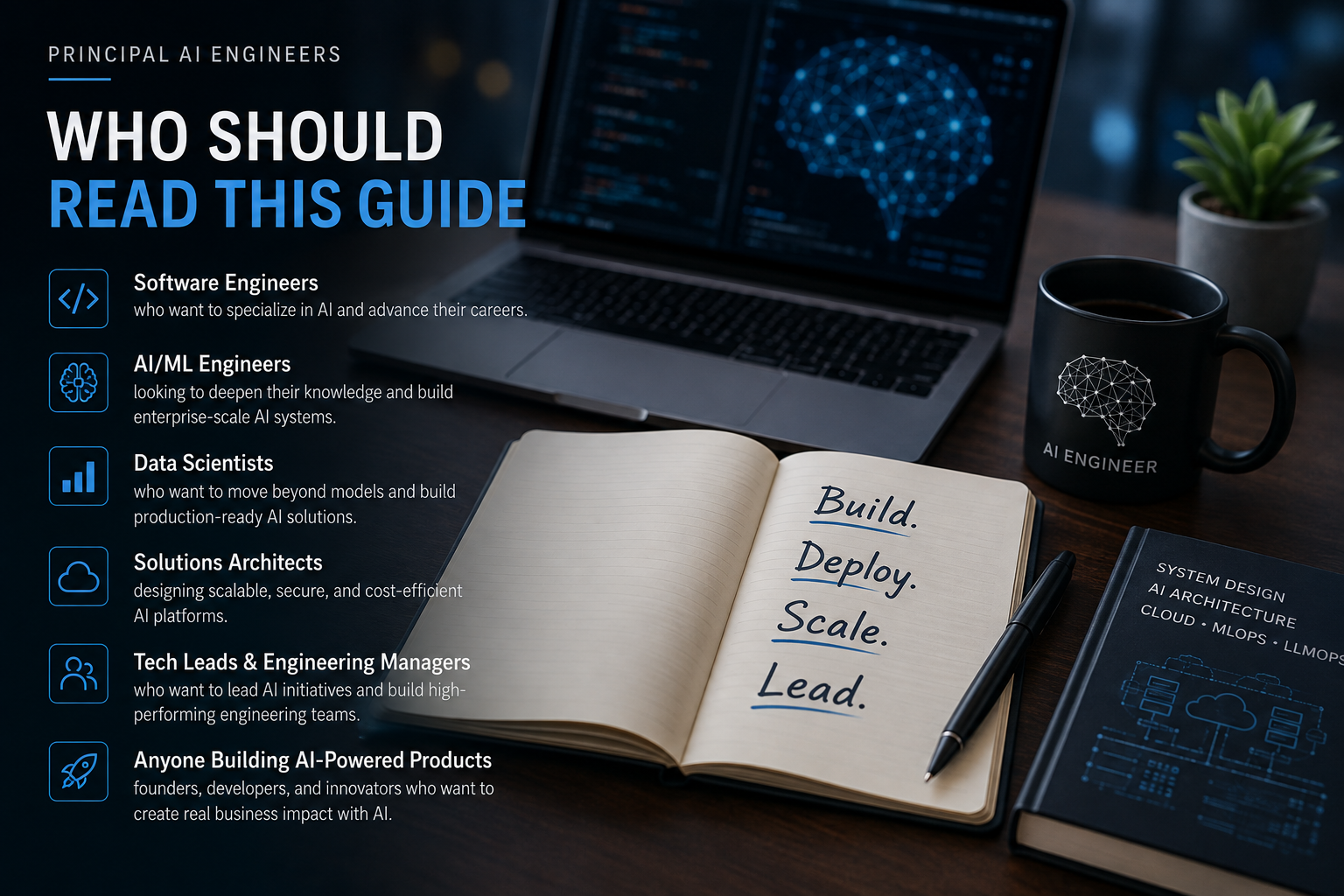
This roadmap is suitable for professionals at different stages of their AI journey, from developers entering the AI domain to experienced architects leading enterprise transformation initiatives.
- Software Engineers transitioning into Artificial Intelligence.
- Backend Developers building AI-powered applications and APIs.
- Senior Developers preparing for Staff, Lead, or Principal engineering roles.
- Machine Learning Engineers expanding into enterprise AI platform engineering.
- DevOps and Platform Engineers deploying AI workloads using Docker and Kubernetes.
- Cloud Architects designing AI-native cloud infrastructure.
- Engineering Managers and Technical Leads driving AI transformation initiatives.
- Solution Architects evaluating enterprise AI architectures and governance.
- Technology enthusiasts seeking a structured roadmap into modern AI engineering.
Career Progression
Becoming a Principal AI Engineer is a progressive journey that combines technical depth, architectural thinking, operational excellence, and leadership. The following roadmap illustrates a common career path followed by enterprise AI professionals.
| Career Stage | Primary Focus |
|---|---|
| Software Engineer | Programming, data structures, APIs, testing, debugging, software engineering fundamentals |
| Senior Software Engineer | System design, scalability, distributed systems, cloud development and mentoring |
| Machine Learning Engineer | Model development, feature engineering, experimentation and deployment |
| Senior AI Engineer | Production AI applications, LLM integration, RAG pipelines, AI APIs and platform development |
| Lead AI Engineer | Platform ownership, architecture decisions, technical leadership, mentoring and delivery |
| Principal AI Engineer | Enterprise AI strategy, cloud-native architecture, AI governance, platform engineering, innovation and organization-wide technical leadership |
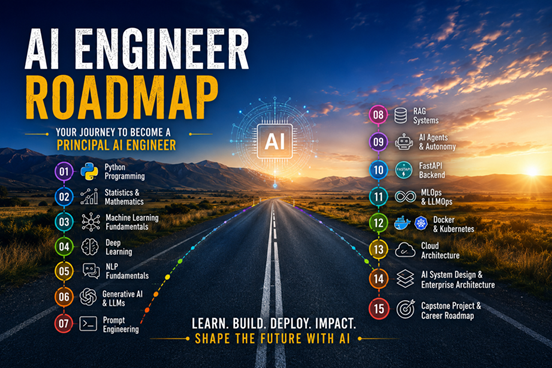
15-Part Learning Journey

The roadmap is organized into fifteen carefully structured chapters. Each chapter builds foundational knowledge before introducing more advanced enterprise AI concepts, ensuring a logical progression from programming fundamentals to production-scale AI platform architecture.
- Computer Science Fundamentals & Python Programming
- Mathematics & Statistics for AI
- Machine Learning Fundamentals
- Deep Learning & Neural Networks
- Natural Language Processing (NLP)
- Generative AI & Large Language Models (LLMs)
- Prompt Engineering & Advanced Prompting Techniques
- Retrieval-Augmented Generation (RAG)
- AI Agents & Agentic AI Systems
- AI Engineering with Python, FastAPI & APIs
- Docker, Kubernetes & Cloud-Native AI Deployment
- MLOps, LLMOps & Production AI Operations
- Cloud AI Platforms & Enterprise Infrastructure
- AI System Design & Enterprise Architecture
- Principal AI Engineer Capstone Project & Career Roadmap
By the end of this roadmap, you will have the knowledge and practical understanding required to architect, build, deploy, monitor, and scale enterprise AI applications while developing the leadership skills expected from a Principal AI Engineer.