Principal AI Engineer Roadmap (2026)
Part 06 – Natural Language Processing (NLP)
Learn how computers understand, analyze and generate human language using classical NLP and modern Transformer-based techniques.
Introduction
Natural Language Processing (NLP) is the branch of Artificial Intelligence that enables computers to understand, interpret, generate and reason over human language. It combines linguistics, machine learning and deep learning to transform unstructured text into actionable business intelligence.
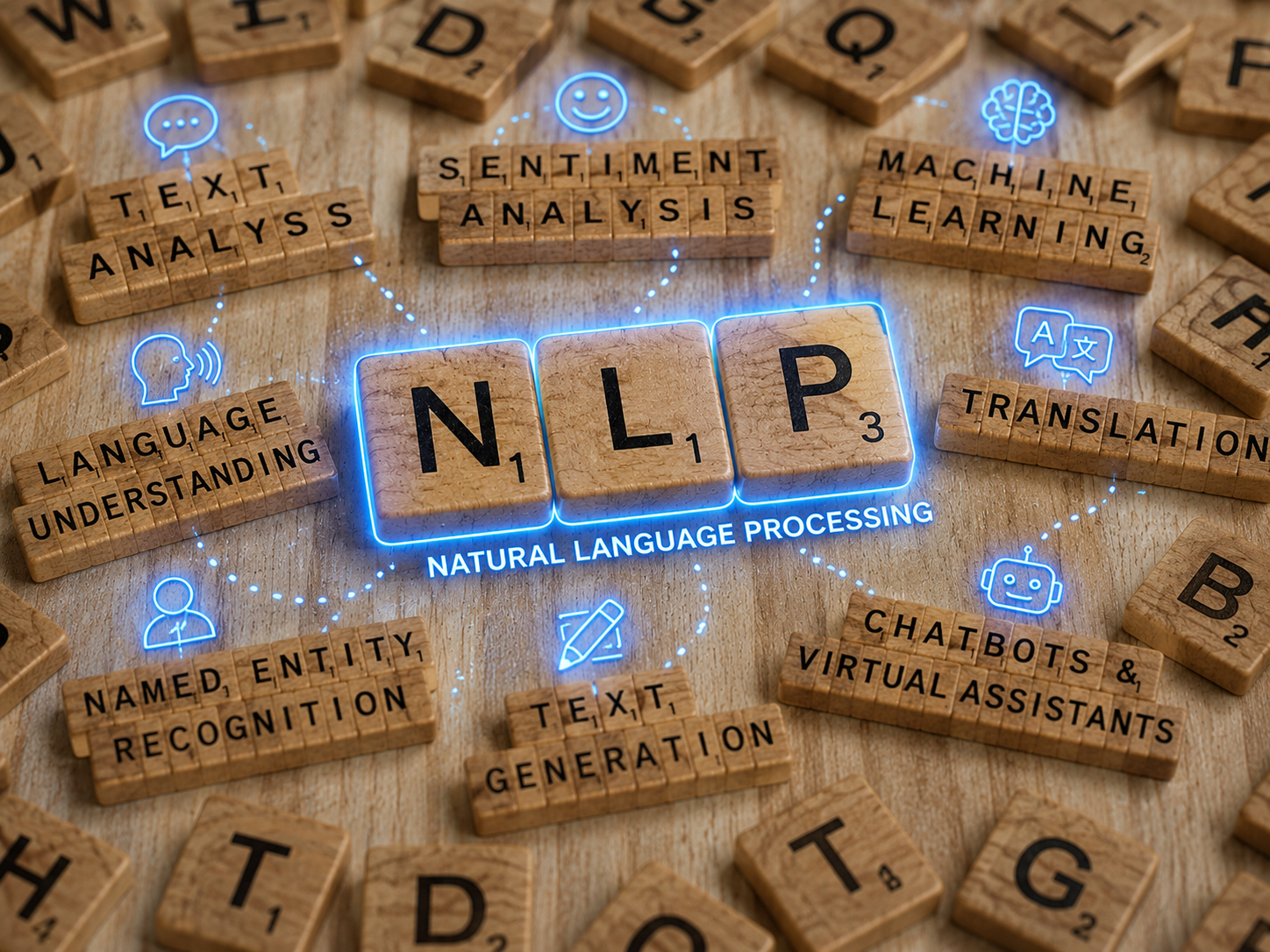
Nearly every modern AI application—including ChatGPT, Microsoft Copilot, Google Gemini, enterprise search, intelligent document processing, virtual assistants and Retrieval-Augmented Generation (RAG)—is built upon NLP technologies.
For a Principal AI Engineer, NLP is no longer limited to text classification or sentiment analysis. It is the foundation for enterprise knowledge management, conversational AI, semantic search, document intelligence and Large Language Models.
Modern AI systems don't simply read text—they understand meaning, relationships, context and intent.
Enterprise NLP Pipeline
- Collect text from enterprise data sources
- Clean and normalize raw documents
- Tokenize words or subwords
- Remove noise and irrelevant content
- Generate embeddings
- Train or fine-tune NLP models
- Evaluate quality and accuracy
- Deploy inference services
- Monitor quality, latency and drift
This same pipeline evolves into Retrieval-Augmented Generation (RAG) and enterprise AI assistants later in this roadmap.
Text Preprocessing
| Technique | Purpose |
|---|---|
| Lowercasing | Normalize text representation |
| Remove HTML & Punctuation | Reduce unnecessary noise |
| Stop-word Removal | Remove common low-value words |
| Lemmatization | Convert words to their dictionary form |
| Spelling Correction | Improve downstream accuracy |
| Emoji & Symbol Processing | Support social media and customer feedback analysis |
Traditional NLP pipelines required extensive preprocessing. Modern Transformer models often perform much of this automatically through advanced tokenization and contextual embeddings.
Tokenization & Embeddings
| Technique | Enterprise Usage |
|---|---|
| Word Tokenization | Classical NLP pipelines |
| Sentence Tokenization | Document analysis |
| BPE / WordPiece / SentencePiece | Large Language Models |
| Word2Vec | Semantic similarity |
| GloVe | Global word representations |
| FastText | Rare and unseen words |
| Sentence Transformers | Semantic Search & Vector Databases |
Embeddings convert human language into high-dimensional vectors that preserve semantic meaning. These vectors power recommendation engines, semantic search, Retrieval-Augmented Generation (RAG) and AI Agents.
Core NLP Applications
| Capability | Business Applications |
|---|---|
| Sentiment Analysis | Customer feedback analysis |
| Named Entity Recognition | Extract people, organizations, products and locations |
| Intent Detection | Virtual assistants and chatbots |
| Machine Translation | Global customer support |
| Question Answering | Knowledge assistants |
| Summarization | Legal, financial and medical documents |
| Semantic Search | Enterprise document discovery |
| Topic Modeling | Knowledge organization |
Transformers Changed Everything
The introduction of the Transformer architecture fundamentally changed Natural Language Processing. Unlike earlier RNN and LSTM models that processed words sequentially, Transformers use self-attention mechanisms to understand relationships across entire documents simultaneously.
This innovation enabled modern foundation models such as BERT, RoBERTa, T5, GPT, Llama, Mistral and many multimodal AI systems.
Every Large Language Model discussed in the next chapter builds upon Transformer architecture.
Python Example (spaCy)
import spacy

nlp = spacy.load("en_core_web_sm")

doc = nlp("OpenAI develops powerful AI models.")

for entity in doc.ents:
    print(entity.text, entity.label_)
Hugging Face Transformers
from transformers import pipeline

classifier = pipeline("sentiment-analysis")

result = classifier("This handbook is outstanding!")

print(result)
Production Best Practices
- Prefer semantic embeddings over keyword matching.
- Store embeddings inside vector databases.
- Detect Personally Identifiable Information (PII).
- Redact confidential enterprise information.
- Continuously monitor hallucinations and response quality.
- Evaluate multilingual performance.
- Combine NLP with Retrieval-Augmented Generation for enterprise knowledge systems.
- Monitor latency, cost and inference throughput.
Enterprise Mini Project
Build an Intelligent Enterprise Document Assistant.
- Upload PDF and Word documents
- Extract document text
- Perform Named Entity Recognition
- Generate document summaries
- Perform sentiment analysis
- Create semantic embeddings
- Expose REST APIs using FastAPI
- Containerize using Docker
This project becomes the foundation for your Retrieval-Augmented Generation (RAG) system in the next chapters.
Enterprise NLP in Action
| Business Scenario | NLP Capability |
|---|---|
| Customer Support Automation | Intent Detection + Question Answering |
| Legal Contract Review | Entity Extraction + Summarization |
| Healthcare Documentation | Medical Entity Recognition |
| Enterprise Knowledge Search | Semantic Search + Embeddings |
| HR Resume Screening | Document Classification |
| Financial Compliance | PII Detection + Document Analysis |
Production Readiness Checklist
- Do I understand how text becomes embeddings?
- Can I explain why semantic search outperforms keyword search?
- Do I understand Named Entity Recognition and document classification?
- Can I build NLP APIs using Hugging Face and FastAPI?
- Do I understand why Transformers replaced RNNs?
- Can I identify where NLP is used inside enterprise AI systems?
- Am I comfortable using embeddings for downstream AI applications?
- Do I understand how NLP naturally evolves into Large Language Models?
Chapter Summary
Natural Language Processing provides the foundation for conversational AI, semantic search, intelligent document processing, Retrieval-Augmented Generation and enterprise knowledge management. More importantly, it introduces the Transformer architecture that powers every modern Large Language Model. The next chapter builds directly on these concepts to explore Generative AI and LLMs in depth.
NLP taught machines to understand language. Large Language Models taught them to generate, reason and collaborate with humans.